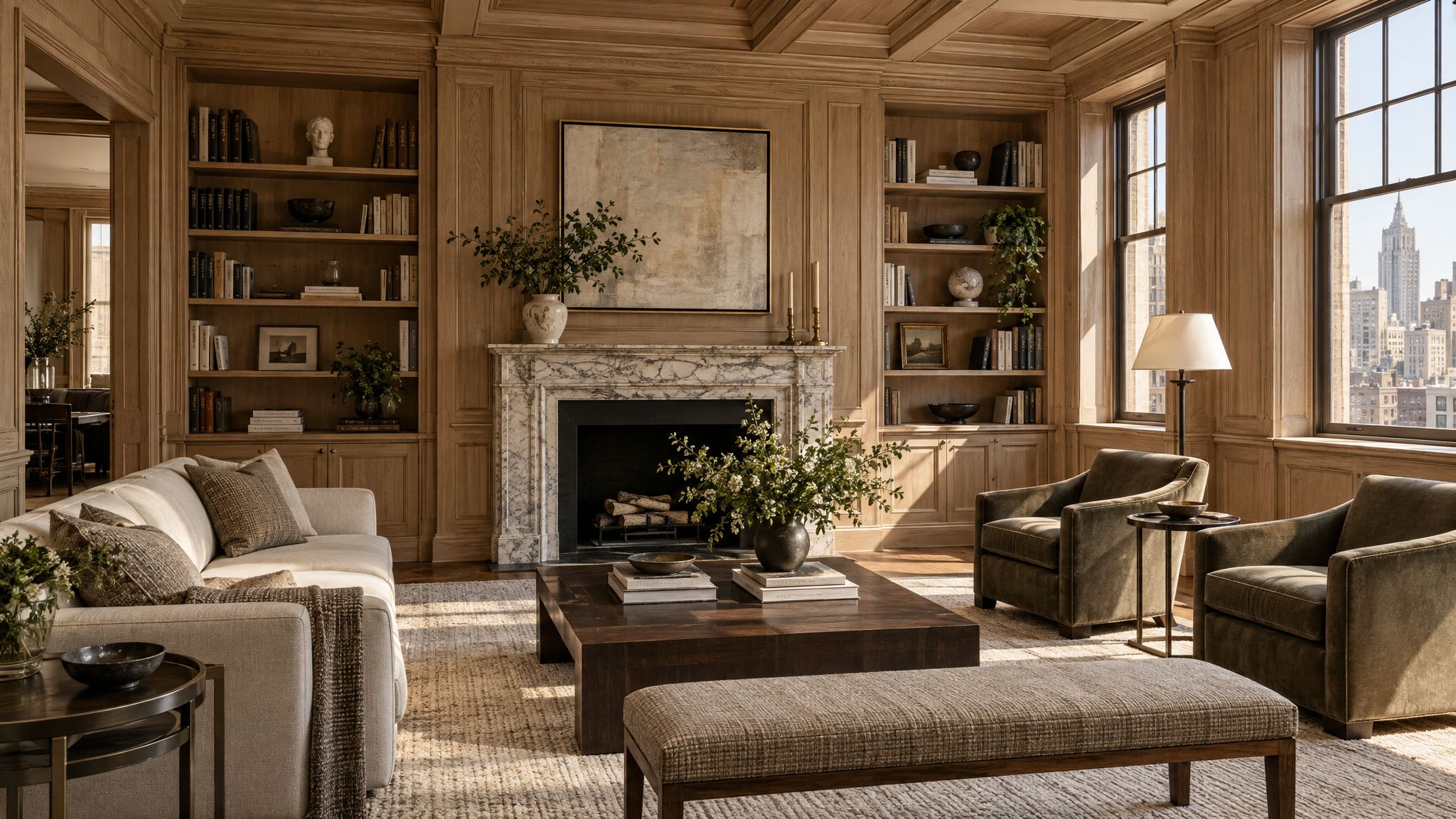
"Architectural millwork" is one of those terms that gets used constantly in design and construction and almost never explained. In short: it's the custom woodwork that becomes part of a building's architecture — the paneling, built-ins, ceilings, trim, and fixtures that define a room rather than simply furnishing it. Here's what it includes, how it differs from cabinetry, and what to know if you're planning it.
Where the term comes from
Historically, a "mill" was where lumber was processed and shaped into moldings, doors, windows, and trim — the woodwork that finished a building. Today, architectural millwork refers to custom-fabricated interior woodwork built to a specific design and installed as a permanent part of a space. It's distinct from both rough carpentry (framing) and freestanding furniture.
What counts as architectural millwork
Wall paneling and wainscoting
From traditional raised-panel wainscoting to full-height, flush veneer walls, paneling is the most recognizable form of architectural millwork. It adds depth, warmth, acoustic softness, and a sense of permanence to a room. See our guides to wall paneling and wainscoting cost in NYC.
Built-in bookcases and library walls
Built-ins that run floor to ceiling, integrate lighting, and wrap around windows or doors are among the most requested pieces we build. They're architecture that happens to hold books. Our library wall cost guide and built-in bookcase design guide cover them in depth.
Ceilings
Coffered, beamed, and paneled ceilings add architectural character to rooms that would otherwise feel flat. They're also technically demanding, because ceilings are rarely level and everything has to align with lighting and HVAC. See coffered ceiling cost in NYC.
Trim, casings, and moldings
Door and window casings, baseboards, crown, and chair rails are the most fundamental form of millwork — and custom profiles can make a new space feel appropriate to an older building. Our article on door casing and interior trim explains what separates builder-grade from custom.
Fireplace surrounds, staircases, and feature elements
Mantels and surrounds, staircase paneling and railings, arched openings, window seats, and entry vestibules all fall under architectural millwork. See our guides to custom fireplace surrounds and staircase millwork.
Commercial millwork
In commercial spaces, architectural millwork includes reception desks, restaurant bars and banquettes, retail fixtures, hospitality casework, and office wall systems. We cover these in our commercial millwork work and in guides on restaurant millwork and reception desks.
How architectural millwork differs from cabinetry
The two overlap — a built-in bookcase is both — but there are real differences. Cabinetry is primarily about storage and function in boxes. Architectural millwork is primarily about shaping the space: it's larger in scale, integrates with walls and ceilings, and must align precisely with other building systems. It also tends to involve more site-specific work, like scribing panels to uneven walls and aligning veneer across an entire room.
That's why architectural millwork depends so heavily on detailed shop drawings and a careful field measure.
Materials and finishes
Architectural millwork can be paint-grade — built from stable materials engineered for a flawless painted finish — or stain-grade, using solid hardwoods and veneers selected for their grain. High-end paneled rooms often use sequenced veneer so the grain flows continuously from panel to panel. Our explainer on veneer matching shows how that's planned, and our guide to quartersawn, riftsawn, and plainsawn lumber explains how the cut changes the look.
Quality standards
The Architectural Woodwork Institute (AWI) defines quality grades — Economy, Custom, and Premium — covering materials, tolerances, joinery, and finish. High-end residential and commercial projects often specify Custom or Premium grade. A shop experienced in architectural work will know these standards and what they require.
What drives the cost
Architectural millwork is typically priced by the linear or square foot, with species, veneer matching, finish, complexity, and site conditions all moving the number. Integrated lighting, curved work, and full-room veneer sequences add cost; paint-grade and simpler profiles reduce it. For ranges, see our architectural millwork cost guide.
Why it's worth doing
Great architectural millwork is the difference between a room that's decorated and a room that's designed. It adds character that furniture can't, it lasts as long as the building, and — done well — it looks like it was always there. That's the standard we build our architectural millwork to, for homes and commercial spaces across New Jersey, New York City, Westchester, and Connecticut.
How an architectural millwork project unfolds
Most projects follow the same arc. It begins with design intent — an architect's or designer's drawings, or a conversation with the homeowner about how a room should feel. The millwork shop then measures the space, develops detailed shop drawings, and prepares finish samples for approval. Once approved, panels, frames, and components are fabricated and finished in the shop, then installed on site in sequence with other trades: after drywall and rough electrical, typically before final painting and flooring protection come off.
Throughout, coordination is constant. Lighting has to land exactly in a cove, a vent grille has to align with a panel reveal, an outlet has to sit centered in a bookcase back. That coordination is invisible when it's done well — which is exactly the point. You can read about the on-site stage in inside a millwork installation.
Residential vs. commercial
Residential architectural millwork tends to prioritize warmth, material richness, and fine detail at close viewing distance. Commercial millwork must also handle heavy use, fire and code requirements, and accessibility standards, often on compressed schedules. Many shops specialize in one; we do both, which means our residential work benefits from commercial durability standards, and our commercial work benefits from residential craft.
Working with an existing building
In older homes and pre-war apartments, new architectural millwork often needs to respect what's already there — matching an existing crown profile, replicating a historic casing, or blending a new paneled wall into original plaster. Custom profile knives let a shop reproduce moldings that are no longer made, so additions read as original rather than new.
If you're considering paneling, built-ins, or a fully millworked room, call us at (201) 281-1457 to talk through your project.