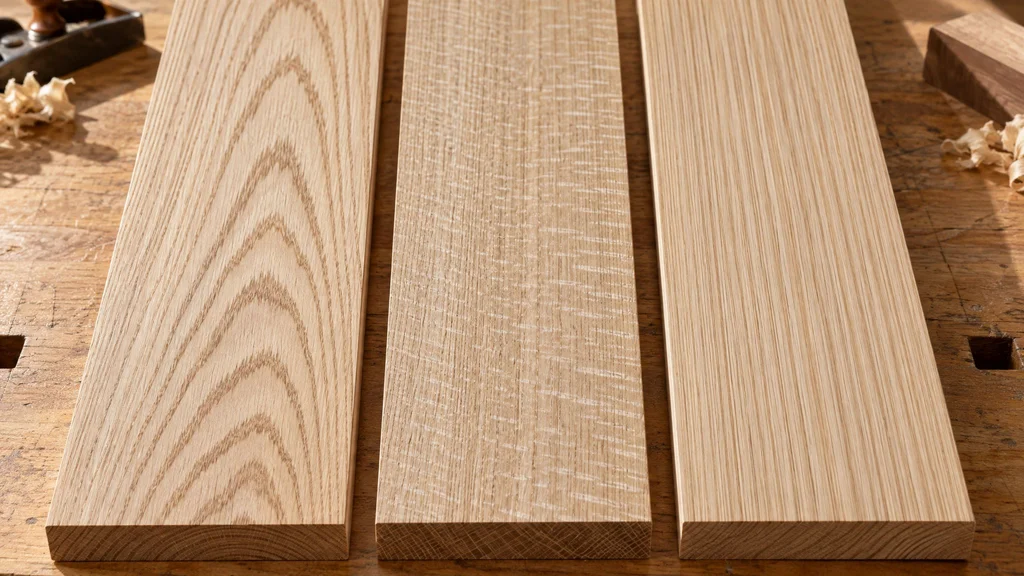
When clients choose "white oak" for their cabinetry, they're often surprised to learn that the choice isn't finished. The same oak tree can produce boards with bold arching grain, dramatic shimmering flecks, or quiet, perfectly straight lines — depending entirely on how the log is cut. The cut affects not just appearance but stability and cost. Here's a clear guide to the three main cuts and how to choose between them.
How logs are cut
Imagine looking at the end of a log and seeing its growth rings as concentric circles. Each sawing method slices through those rings at a different angle, and that angle determines the grain pattern on the board's face.
Plainsawn (flatsawn)
Plainsawn lumber is cut by slicing the log straight through in parallel cuts. Most boards end up with growth rings running roughly parallel to the face, producing the classic "cathedral" pattern — arches and loops that most people picture when they think of wood grain.
Look: bold, varied, traditional, with lots of movement.
Stability: the least stable of the three. Plainsawn boards expand and contract more across their width and are more prone to cupping.
Cost: the most economical, since it yields the most usable lumber from a log with the least waste.
Best for: rustic and traditional designs, furniture where grain character is welcome, and projects where budget matters.
Quartersawn
Quartersawn lumber is cut from logs first divided into quarters, then sliced so the growth rings run nearly perpendicular to the board's face — typically between 60 and 90 degrees. This produces straight, tight grain lines. In oak specifically, quartersawing exposes the medullary rays — ribbon-like cells radiating from the center of the tree — as shimmering flecks and ribbons across the surface. This "ray fleck" is quartersawn oak's signature.
Look: straight grain with dramatic flake figure in oak; associated with Arts and Crafts and Mission furniture.
Stability: very stable; moves mostly in thickness rather than width, and resists cupping and twisting.
Cost: more expensive due to lower yield and more labor.
Best for: traditional and Craftsman interiors, heirloom furniture, and anyone who loves the fleck figure.
Riftsawn
Riftsawn lumber is cut so the growth rings meet the face at roughly 30 to 60 degrees — an angle that avoids exposing the medullary rays. The result is extremely straight, consistent, linear grain with little or no fleck.
Look: clean, calm, uniform stripes; the most contemporary of the three.
Stability: the most stable cut, with very even movement.
Cost: typically the most expensive, because the cutting method wastes the most of the log.
Best for: modern and minimalist kitchens, paneling, continuous-grain cabinet runs, and any design that wants quiet, linear texture. See our rift-sawn white oak guide.
Live sawn
A fourth approach, live sawing, slices the entire log without turning it, producing boards that include all three grain patterns. It's valued in some flooring and furniture for its natural variety.
How the cut applies to veneer
The same principles apply to veneer slicing. Plain-sliced veneer shows cathedral grain; quarter-sliced shows straight grain and fleck in oak; rift-cut veneer shows straight, fleck-free grain. Because veneer yields more surface area per log, it makes premium cuts like rift more practical for large projects such as full kitchens and paneled rooms. See veneer matching explained and veneer vs. solid wood.
Stability matters more than you'd think
Because plainsawn wood moves more across its width, it's more likely to cause gaps, cupping, or cracks in finishes — particularly in wide panels or humid rooms. Quartersawn and riftsawn lumber move more predictably and less across the face, which is why they're prized for high-end cabinetry, doors, and paneling. We explain why this matters in wood movement and custom cabinetry.
Species beyond oak
These cuts apply to all species, but the visual differences are most dramatic in oak because of its pronounced rays. In walnut, cherry, and maple, quartersawn and riftsawn boards produce straighter, more uniform grain, while plainsawn boards show more figure. Some species, like sycamore, show striking figure when quartersawn. Our walnut vs. white oak comparison discusses species character.
Choosing a cut for your project
- Contemporary kitchen with slab doors: rift white oak, often veneered, for calm consistency.
- Traditional or Craftsman interior: quartersawn oak for its fleck and heritage.
- Rustic or farmhouse design: plainsawn for character and value.
- Paneled library or study: quartersawn or rift, depending on whether you want pattern or calm.
- Horizontal continuous grain: rift veneer. See vertical vs. horizontal grain doors.
How the cut affects stain
Different cuts take stain differently. Quartersawn oak's rays resist stain, so the fleck stays lighter than the surrounding wood — a beautiful effect that intensifies with darker stains. Riftsawn oak stains very evenly. Plainsawn boards can show more variation between earlywood and latewood. Always sample on the actual cut you'll use; see custom wood stain matching.
Cost and availability
Expect plainsawn to be the most affordable, quartersawn to cost more, and riftsawn to be the premium option, with prices varying by species, board width, and market conditions. For large projects, the difference adds up, which is why cut selection is a real budget conversation — not just an aesthetic one.
A quick way to identify the cut
Look at the end grain of a board. If the growth rings run roughly flat across the end, it's plainsawn. If they run nearly vertical, it's quartersawn. If they run at a diagonal, it's riftsawn. On the face, look for the telltale signs: cathedral arches mean plainsawn, flecks and ribbons mean quartersawn oak, and uniform straight stripes mean rift. Once you've seen them side by side, you'll start noticing the difference everywhere — in furniture, floors, and cabinetry.
Ask any shop you're considering which cut they plan to use — the answer tells you a lot about how carefully they think about materials.
We work in all three cuts across our kitchens, architectural millwork, and custom furniture. If you'd like to see and touch samples side by side, visit our Little Falls shop or call (201) 281-1457.