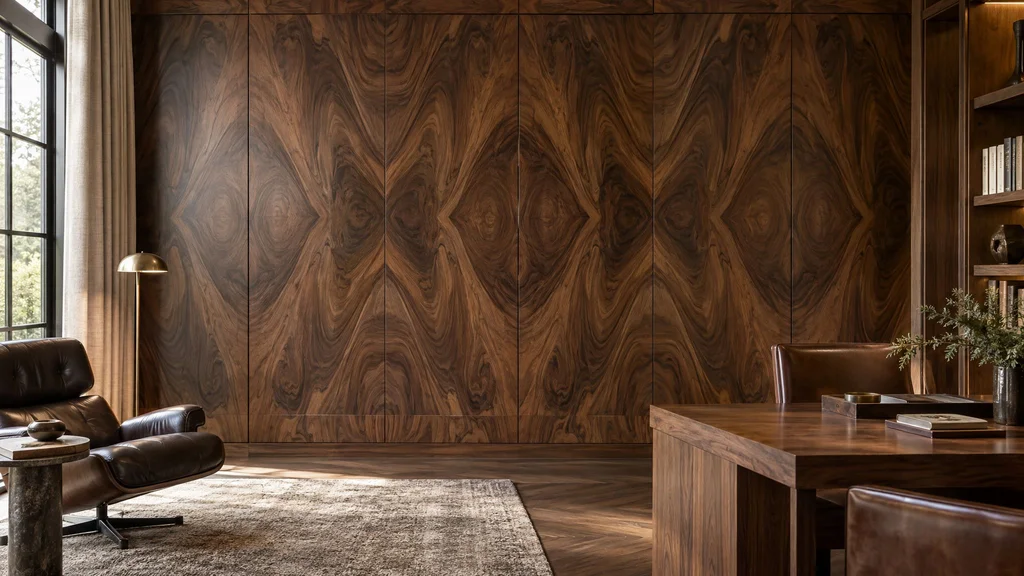
Veneer — thin slices of real wood laid onto a stable core — is behind some of the most spectacular woodwork in the world, from Art Deco paneled lobbies to contemporary kitchens with grain that flows seamlessly from one door to the next. But veneer's beauty depends almost entirely on how it's arranged. The same log can produce a serene wall or a restless one. Here's how veneer matching works and how to choose the right approach for your project.
First: what veneer is
Veneer is produced by slicing a log (or a section of one, called a flitch) into thin sheets called leaves. Because the leaves come off the log in order, adjacent leaves are nearly identical, and their grain patterns can be arranged deliberately. Laid onto a stable substrate, veneer allows large, flat, dimensionally stable panels with grain figure that would be impossible — or wildly expensive — in solid lumber. We compare veneer and solid wood in detail in wood veneer vs. solid wood.
How the log is cut affects the figure
Before matching comes slicing. Plain-sliced veneer shows cathedral-like arches. Quarter-sliced veneer shows straight, parallel grain, often with flake figure in oak. Rift-cut veneer produces very straight, linear grain without flake. Rotary-cut veneer, peeled around the log, creates wide, bold patterns. Our guide to quartersawn, riftsawn, and plainsawn explains the same principles in solid lumber, and rift-sawn white oak covers one of today's most popular choices.
Matching leaves within a panel
Book match
Adjacent leaves are opened like the pages of a book, so each leaf is a mirror image of the next. The result is symmetrical patterns that meet at the seam — sometimes creating striking shapes, especially in figured woods. Book matching is the most common and recognizable matching method in high-end paneling and furniture. One subtle effect: because every other leaf is flipped, light reflects differently off alternate leaves, creating a gentle "barber pole" shimmer that's part of the look.
Slip match
Adjacent leaves are slid side by side without flipping, so the grain pattern repeats across the panel. Slip matching works especially well with straight-grained veneers like rift oak, producing a uniform, rhythmic look with consistent color because all leaves face the same way.
Random match
Leaves are arranged without regard to pattern, sometimes from different flitches, creating a casual, board-like appearance. It's less formal and can be a good choice for rustic or relaxed interiors.
Specialty matches
Four-way book matches, diamond matches, sunburst patterns, and other geometric layouts are used for tabletops, feature panels, and decorative doors. They're dramatic and require careful planning and skilled layup.
Matching across panels
Within a single panel is only half the story. When a room has many panels — a wall of cabinet doors, a paneled library — the relationship between panels matters just as much.
- Running match: leaves are used in order across panels without regard to where a leaf is split; efficient but less refined.
- Balance match: each panel contains leaves of equal width, creating symmetry within each panel.
- Center match: panels have an even number of leaves with a seam in the center.
- Sequence match: panels are laid out in the order the veneer came off the log, so the grain flows continuously from one panel to the next across a wall or run of cabinets.
Sequence matching is what makes the finest paneled rooms and kitchens feel like a single, continuous surface. It requires planning the entire elevation before a single panel is pressed, and reserving enough veneer from the same flitch to complete the job — including allowances for doors, drawer fronts, and end panels.
Flitch selection
For important projects, we select the actual flitch of veneer — reviewing the bundle of consecutive leaves to evaluate color, figure, and consistency. It's the equivalent of choosing a stone slab rather than ordering "marble." Designers often join us for this step. We describe that collaboration in working with your designer on millwork.
Grain direction and composition
Matching also involves deciding whether grain runs vertically or horizontally. Horizontal grain flowing across a run of drawers creates calm, architectural lines; vertical grain emphasizes height. Many refined kitchens combine both deliberately. See vertical vs. horizontal grain doors.
Finishing veneer
Because veneer is thin, finishing must be done carefully — aggressive sanding can cut through the face. Book-matched panels may show slight color differences between alternate leaves under certain light; skilled finishing minimizes this while preserving the natural shimmer. Read about the process in inside the spray booth.
Where veneer matching matters most
- Paneled walls and libraries
- Slab-door kitchens in walnut, oak, or exotic species
- Statement islands and furniture pieces
- Commercial lobbies, reception desks, and hospitality spaces
- Built-in media walls and closet fronts
Cost considerations
Sequence-matched and specially selected veneers cost more — both in material, because you need enough from one flitch, and in labor, because layout and layup take time. For focal walls and primary rooms, the investment is usually worth it; for secondary spaces, a simpler match can be a sensible choice. Our architectural millwork cost guide discusses how these choices affect budgets.
Seeing it in person
Veneer vs. "wood-look" surfaces
It's worth distinguishing real wood veneer from printed laminates and thermofoil, which imitate wood grain with a photographic layer. Real veneer has depth, reacts to light, and ages naturally; printed surfaces repeat their pattern and can't be refinished. Both have their place, but only real veneer can be matched, sequenced, and finished the way we describe here. Our comparison of painted, veneer, and thermofoil doors covers the practical differences.
One last tip: ask to see the flitch before it's committed to your project. Two bundles of the same species can differ enormously in color and figure, and choosing the right one is often the single most important decision in a veneered room.
Veneer matching is hard to appreciate in photos and unforgettable in person. If you're considering a paneled room, a veneered kitchen, or a statement piece, we'd be glad to show you samples and past work at our Little Falls shop. Our architectural millwork and kitchen projects often begin with exactly that conversation — call (201) 281-1457.