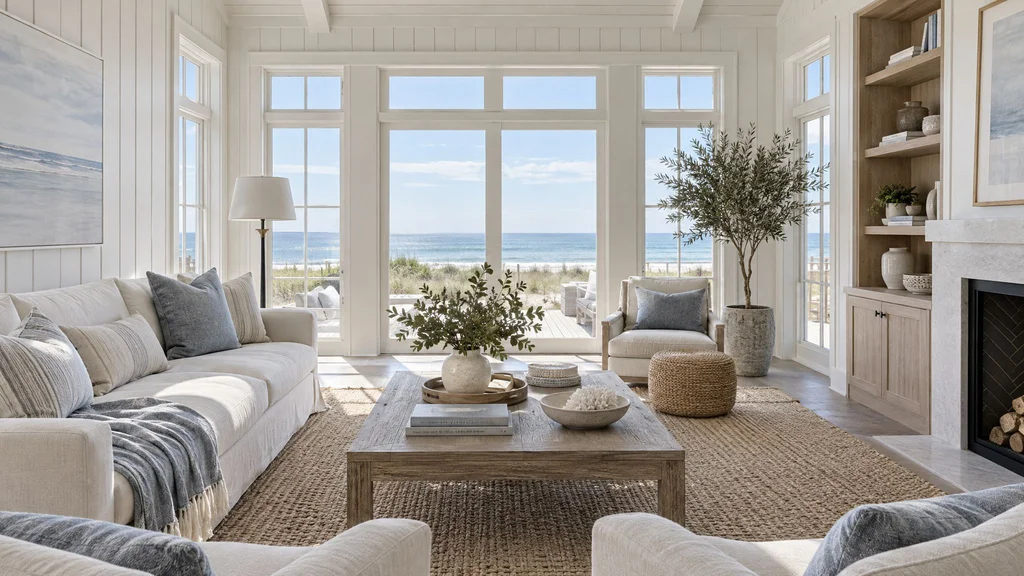
A house in the Hamptons lives a different life from a home in the city or suburbs. It may sit within sight of the ocean or bay, breathe salty, humid air all summer, and be closed up for months in winter with the heat turned down. Those conditions are tough on woodwork. Doors that fit perfectly in May can stick in August; finishes can cloud; hardware can pit and corrode. The good news is that careful material choices and construction methods make coastal millwork just as durable as anywhere else. This guide covers what works on the East End, from Southampton and Bridgehampton to East Hampton, Amagansett and Montauk.
What salt air and humidity do to millwork
Wood is hygroscopic: it absorbs and releases moisture from the air, expanding and contracting across its grain as it does. Coastal homes see bigger humidity swings than most, especially seasonal houses that go from closed and dry to open and humid. That movement causes panels to crack, joints to open, doors to bind and paint to split along seams. Salt air adds corrosion of metal hardware and fasteners and can degrade some finishes. Direct sun near the water accelerates fading and finish breakdown. See our deep dive on wood movement in custom cabinetry.
Wood species that handle the coast
- White oak: dense, stable when quartersawn or rift-sawn, and naturally resistant to moisture thanks to its closed cell structure. It's the classic choice for coastal cabinetry and built-ins. See quartersawn, rift-sawn and plain-sawn.
- Teak and iroko: naturally oily and extremely durable, ideal for outdoor kitchens, showers and areas near pools.
- Mahogany: stable and rot-resistant, suited to exterior doors and windows as well as interior millwork.
- Cypress and cedar: lightweight and rot-resistant, useful for porches, outdoor showers and closet lining. See cedar closet lining.
- Painted poplar or maple: popular for painted interior cabinetry, but should be paired with stable construction and a sealed finish.
For a broader comparison, read our cabinet materials comparison and veneer vs. solid wood.
Construction methods that resist movement
Construction matters as much as species. For coastal millwork, we favor:
- Stable cores: veneered panels over high-quality plywood or MDF cores move far less than wide solid-wood panels.
- Floating panels: in frame-and-panel doors, the panel floats in a groove so it can expand without cracking the frame.
- Engineered wide boards: for paneling and board-and-batten, engineered materials or narrow boards reduce seasonal gaps. See shiplap vs. board and batten.
- Acclimation: materials should acclimate to the house's conditions before installation, and ideally the house should be climate-controlled during installation.
Finishes for coastal homes
Every surface of a coastal cabinet, including backs, edges and the insides of doors, should be sealed so moisture enters evenly. Catalyzed lacquers and conversion varnishes provide durable, moisture-resistant film finishes for painted and stained cabinetry. Hardwax oils like Rubio Monocoat give a natural look and are easy to repair, but need periodic maintenance. For exterior applications, marine-grade finishes and UV inhibitors matter. See our cabinet finishes guide and spray booth finishing post.
Hardware that won't corrode
Salt air attacks metals. Solid brass and bronze develop a patina rather than rust, and many owners love the way they age. Unlacquered brass, in particular, suits coastal houses. Stainless steel in marine grade 316 resists corrosion better than standard 304. Plated finishes over steel can fail quickly near the ocean. Hinges, drawer slides and fasteners should also be chosen for corrosion resistance. See our hardware finishes guide and brass hardware guide.
Seasonal-home considerations
Houses closed for the winter present special challenges. When heat is lowered and the house sits dry for months, wood shrinks; when it opens in spring and humidity returns, wood swells. To protect millwork:
- Keep indoor humidity steady year-round, ideally between 35 and 50 percent, using a humidifier in winter and dehumidification or air conditioning in summer.
- Maintain modest heat rather than shutting it off entirely.
- Ask your house manager to open cabinets periodically and check for issues.
- Plan annual maintenance: adjusting doors, touching up finishes and oiling natural wood surfaces.
Coastal design vocabulary
Hamptons interiors favor light, airy spaces: painted paneling, board-and-batten or beadboard walls, white oak floors and built-ins, linen and natural textures. Popular millwork features include built-in window seats (see window seats with storage), open shelving, glass-front cabinetry, custom wainscoting, beamed ceilings, home bars for entertaining, wine rooms, and mudrooms that handle sand, towels and beach gear.
Planning and logistics
East End projects involve longer drive times and seasonal traffic, so planning installation windows matters. Many owners prefer work completed in the off-season so the house is ready for summer. Coordinate with your builder so the house is weathertight and climate-controlled before millwork is delivered. For costs, see custom furniture and millwork costs and architectural millwork costs. For storage in a guest-heavy summer house, see walk-in closet design.
Frequently asked questions
Is solid wood a bad idea near the ocean? Not necessarily. Stable species, narrow boards, quartersawn or rift-sawn lumber and proper construction make solid wood work. Wide panels are best in veneer.
Will unlacquered brass turn green? It will darken and can develop verdigris over time in salty air. Many owners love the patina; regular polishing keeps it brighter.
A coastal millwork checklist
- Specify stable species and rift-sawn or quartersawn lumber for solid-wood parts.
- Use veneered panels on stable cores for wide doors, paneling and cabinet sides.
- Seal every surface, including backs, edges and interiors, with a durable finish.
- Choose solid brass, bronze or marine-grade stainless hardware, hinges and fasteners.
- Make sure the house is weathertight and climate-controlled before millwork arrives.
- Keep humidity steady year-round, even when the house is closed for the season.
- Schedule a yearly check to adjust doors and touch up finishes before summer opening.
Following these steps keeps coastal millwork looking crisp season after season, and keeps small issues from becoming expensive repairs.
Related reading: Fairfield County custom cabinetry, luxury kitchens in Westchester.
Can you work on Long Island's East End? Yes, we take projects across the region, including Long Island. See our Great Neck and Roslyn area pages and our architectural millwork service.