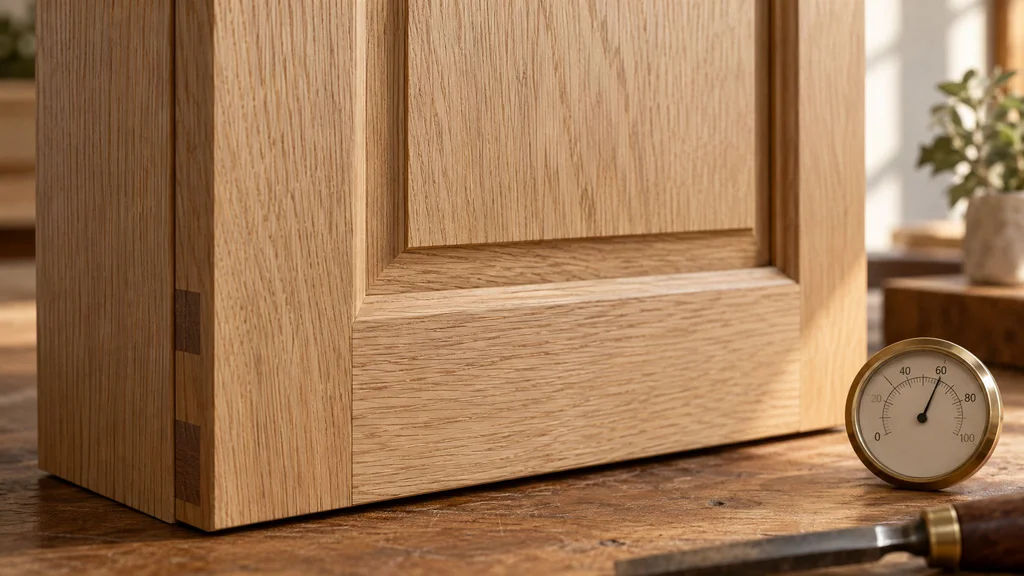
Every so often, a client calls in January to say a hairline has appeared at the joint of a painted cabinet door, or that a door that closed perfectly in August is suddenly a hair tight. Our answer is almost always the same, and it's reassuring: that's wood being wood. Solid wood is a natural material that responds to humidity, and it never stops doing so. Understanding how it moves — and how good cabinetry is designed around that movement — takes the mystery out of these seasonal changes and helps you tell the normal from the problematic.
Why wood moves
Wood is made of cellulose fibers that absorb and release moisture from the air. When the air is humid, wood takes on moisture and swells; when the air is dry, it releases moisture and shrinks. This happens even after wood is dried, finished, and installed. A finish slows the exchange of moisture but doesn't stop it.
Wood moves differently in different directions
Wood moves very little along its length — along the grain — but significantly across its width. A board may change in width by a noticeable fraction of an inch across a year while barely changing in length. This is why a wide solid-wood panel can shrink and swell across its width while the frame around it, whose grain runs lengthwise, stays essentially the same size. It's also why the way a board is cut matters: quartersawn and riftsawn boards move less across their faces than plainsawn boards. See quartersawn vs. riftsawn vs. plainsawn.
Seasonal cycles in the Northeast
In New Jersey and New York, the seasonal swing is significant. Summers are humid; winters, with heating systems running, can be very dry — often well below 30 percent relative humidity indoors. Wood swells in summer and shrinks in winter. Most movement-related questions we get arrive in the first cold snap of the heating season.
How good cabinetry accommodates movement
Floating panels
In a traditional frame-and-panel door, the solid center panel isn't glued into the frame. It "floats" in grooves, free to expand and contract without cracking the frame or itself. Small rubber spacers keep it centered and prevent rattling. This centuries-old technique is the foundation of solid-wood cabinetry.
Stable cores for wide surfaces
For slab doors, wide panels, and large flat surfaces, veneer over a stable engineered core dramatically reduces movement, which is why veneer is preferred for continuous-grain and contemporary slab designs. See veneer vs. solid wood.
Appropriate joinery
Joints are designed to hold strongly along the grain while allowing movement where needed. Tabletops, for example, are attached with fasteners that let them move rather than being screwed rigidly.
Acclimation
Before fabrication and installation, materials should acclimate to conditions similar to the home's. Installing cabinetry into a newly plastered, unheated, damp space invites problems later. We cover site conditions in inside a millwork installation.
Sealing all surfaces
Finishing every surface — fronts, backs, edges, and interiors — helps wood absorb and release moisture evenly, reducing warping. See inside the spray booth.
What's normal
- Hairline lines at painted joints: on five-piece painted doors with solid-wood frames, a fine line may appear where stiles and rails meet as the wood moves seasonally. This is expected and doesn't indicate a structural problem. Construction choices minimize it, but no one can eliminate it entirely in solid wood.
- Exposed unfinished edges on floating panels: in winter, a panel may shrink slightly and reveal a thin strip of edge that wasn't visible in summer. Quality shops pre-finish panels before assembly to prevent this.
- Slight changes in door fit: a door may feel a little tighter in humid months or show a slightly larger gap in dry months. Hinges can be adjusted.
- Color change: not movement, but related — wood changes color with light exposure over months and years. Oak warms, walnut lightens, and cherry deepens.
What's not normal
- Large gaps or cracks that continue to widen year after year.
- Panels that split through their width.
- Severe warping or cupping of doors that prevents closing.
- Finish peeling or delaminating.
- Swelling in sink bases — usually a sign of a water leak, not humidity.
If you see any of these, contact your cabinetmaker. They usually indicate a construction issue, extreme conditions, or water intrusion.
Painted cabinetry and movement
Painted solid-wood doors show movement more than stained doors because paint forms a continuous film across joints; when the wood shifts, the film shows a line. Using stable materials like MDF for center panels, choosing construction methods that reduce joint movement, and maintaining steady indoor humidity all help. We discuss the trade-offs in painted vs. stained cabinets and painted vs. veneer vs. thermofoil.
Protecting your millwork with humidity control
The single most effective thing you can do is keep indoor humidity reasonably stable — ideally in the 35 to 55 percent range year-round. A whole-house humidifier for winter and air conditioning or dehumidification in summer reduce seasonal swings dramatically. This protects not just cabinetry but hardwood floors, doors, trim, pianos, and art. An inexpensive hygrometer lets you monitor conditions.
Bathrooms and wet areas
Bathrooms add rapid humidity spikes from showers. Ventilation, sealed finishes, and moisture-resistant materials are essential. See best wood for a bathroom vanity.
How we handle it
We design every piece with movement in mind, pre-finish panels, choose stable cuts and cores where appropriate, and explain what to expect before installation. We also return after the first heating season to adjust doors as the cabinetry settles into its new environment. It's part of building cabinetry that lasts decades — something we explain in how custom cabinets are made.
In short: movement is a sign that your cabinetry is made of real wood. Designed and cared for properly, it's something you'll barely notice.
If you ever have a question about something you're seeing in your cabinetry, send us a photo — most of the time, it's a quick answer.
Questions about how wood will behave in your home? Call us at (201) 281-1457 — we're glad to talk through your kitchen or millwork project.