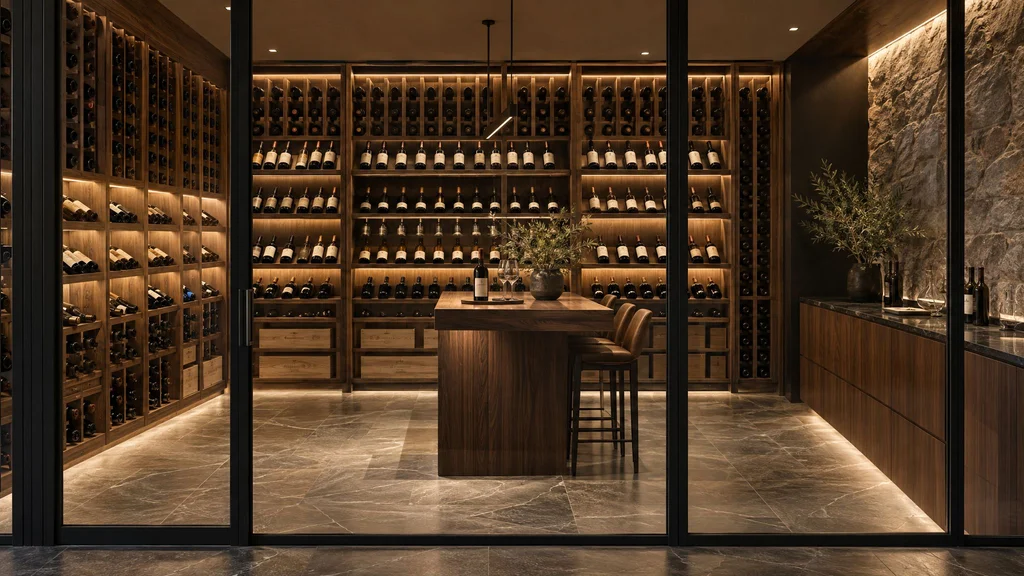
A wine room is where craftsmanship meets preservation. It has to do two jobs at once: protect bottles from the heat, light, and dryness that damage wine, and display a collection in a way that makes you want to open the door. Whether you're planning a glass-enclosed wine wall off the dining room or a full cellar in a New Jersey basement, here's how we think about custom wine room design.
Wine's needs come first
Wine ages best in consistent conditions. Most experts recommend a temperature around 55°F, relative humidity roughly between 50 and 70 percent, darkness or limited light, minimal vibration, and bottles stored on their sides so corks stay moist. Fluctuations matter more than the exact number — steady conditions are the goal. Every design decision flows from maintaining that environment.
Cooling systems
A true wine room needs a dedicated cooling system, not just the home's HVAC. Options include through-the-wall units, ducted split systems (with the noisy components located elsewhere), and ductless split systems. The right choice depends on room size, insulation, glass area, and noise tolerance. A cooling specialist should size the system; we coordinate the millwork around it, including access for maintenance.
Construction: insulation and vapor barrier
A wine room must be insulated and sealed with a vapor barrier on the warm side, and have a well-sealed, exterior-grade door. Without these, the cooling system works constantly, condensation forms, and wood racking and finishes can suffer. This construction happens before millwork is installed, and it's essential to the room's success.
Glass enclosures
Glass walls turn a wine room into a showpiece visible from dining and living areas. Glass reduces insulation, so insulated glazing and properly sized cooling are important. Frameless or minimally framed glass with metal or wood frames can suit contemporary or traditional interiors.
Racking styles
Individual bottle racking
Each bottle has its own cradle, making it easy to find and remove any bottle. Efficient and organized for larger collections.
Label-forward display
Bottles are presented with labels facing out at an angle, turning favorites into a visual display. Uses more space per bottle but looks spectacular.
Bulk storage bins
Diamond bins or cubes hold multiple bottles of the same wine — efficient for cases.
Case storage
Open shelves for full wooden cases, useful for collectors who buy by the case.
Magnum and large-format racks
Larger openings for magnums and special bottles.
Most wine rooms combine several styles: bulk storage for everyday wines, individual racks for the collection, and display for special bottles.
Materials
Wood species used in wine rooms should tolerate cool, humid conditions and not impart odors. Stable, rot-resistant hardwoods are traditional; walnut and white oak are popular for their appearance. Finishes should be low-odor and suitable for humidity, and some collectors prefer unfinished or naturally finished racks to avoid any odor transfer. Metal racking — often combined with wood — offers a contemporary look and slim profiles. For material behavior in humid spaces, see wood movement and custom cabinetry.
Lighting
Light, especially UV, can harm wine, so lighting should be low-UV LED and ideally on a timer or dimmer. Integrated LED strips along racks and display shelves create dramatic effects without adding heat. Keep lighting off when the room isn't in use.
Tasting areas
A small counter or table inside or just outside the wine room creates a place to open, decant, and taste. Some clients add a sink, glass storage, and a wine refrigerator for serving temperatures outside the room. See designing a custom home bar for adjacent ideas.
Capacity planning
Estimate your current collection and how fast it grows, then plan capacity with room to expand. Collections almost always grow faster than expected. Mixing racking types allows flexibility.
Wine walls and smaller solutions
Not every home has room for a full cellar. A glass-enclosed wine wall in a dining room, a wine closet under the stairs, or a temperature-controlled cabinet within a kitchen or bar can hold a meaningful collection. In apartments, a built-in wine refrigerator column integrated into cabinetry is often the right answer.
Security and inventory
A locking door protects valuable collections. Some collectors add inventory management systems or labeling on racks. Plan space for these considerations early.
Cost factors
Cost depends on room size and capacity, cooling system, construction (insulation, vapor barrier, door, glass), racking style and material, lighting, and tasting-area features. Label-forward display racking costs more per bottle than bulk storage. For related context, see our custom furniture and millwork cost guide.
Where we build wine rooms
Frequently asked questions
Can I convert a closet into a wine room? Often, yes. A closet can be insulated, sealed, fitted with a cooling unit and door, and racked to hold a few hundred bottles.
Do wood racks need a finish? Many collectors prefer unfinished or naturally oiled racks to avoid any odor; if a finish is used, it should be fully cured, low-odor, and suited to humidity.
How loud are cooling systems? Through-wall units can be audible; ducted and split systems place the noisy components elsewhere, which is why they're preferred near living spaces.
Can a wine room be in a warm part of the house? Yes, with proper insulation and a correctly sized cooling system, though basements are naturally more stable.
How much space does each bottle need? Individual racking typically allows a slot about 3½ to 4 inches wide per standard bottle, with larger openings for magnums and display rows.
Planning checklist
- Count your current bottles and estimate growth over the next five years.
- Choose the cooling system with a specialist before designing racking.
- Confirm insulation, vapor barrier, and door before millwork begins.
- Decide on the mix of display, individual, and bulk storage.
Plan generously, and you'll enjoy your collection for decades.
Related reading: home gym millwork design, millwork for Hamptons homes.
We've built wine storage from compact wine walls in Manhattan apartments to basement cellars in Bergen and Morris County homes. Each starts with understanding the collection and the collector. If you'd like to design a wine room, call (201) 281-1457 to talk about custom furniture and built-ins.