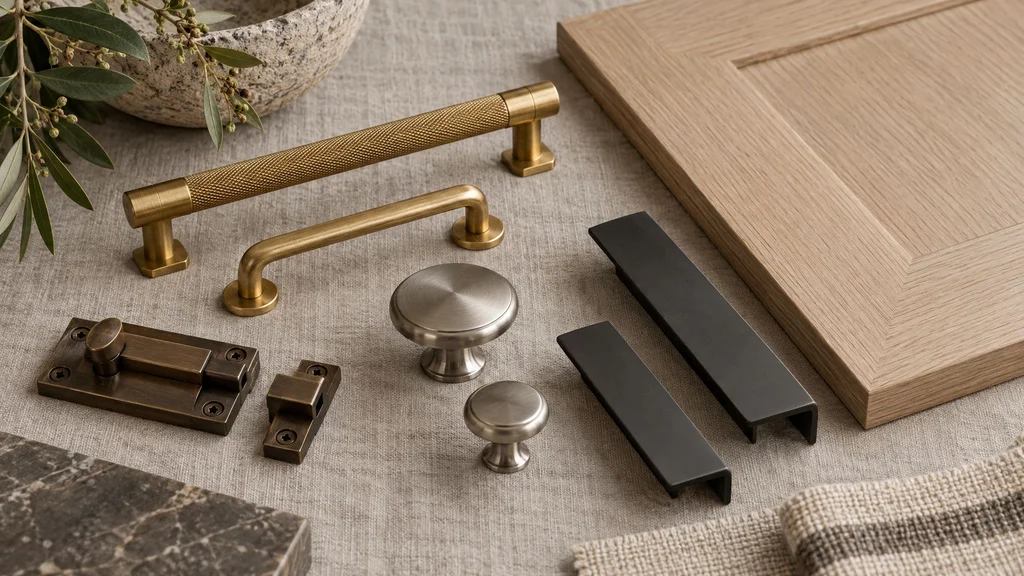
Cabinet hardware is small, but it has an outsized effect on how a kitchen or bath looks and feels. It's the jewelry of the room — the element that ties cabinetry to faucets, lighting, and appliances — and it's the part of your cabinetry you'll physically touch thousands of times a year. Choosing well means thinking about finish, feel, durability, and how the finish will age. Here's our guide.
Start with how you want it to age
The most important question isn't which finish is prettiest in the showroom — it's how you want it to look in ten years. Some finishes are designed to stay exactly the same; others are designed to change. "Living" finishes like unlacquered brass develop a patina with handling, which some clients love and others find untidy. Decide which camp you're in first.
The main finishes
Unlacquered brass
Raw brass with no protective coating. It starts bright and darkens over time into a warm, antique patina, with high-touch areas staying brighter. It's beloved for its warmth and character and suits traditional, transitional, and warm contemporary kitchens. It can be polished back to shine if you prefer. It's a living finish — embrace the change or choose something else.
Lacquered and PVD brass
Brass with a protective coating (lacquer) or a durable physical vapor deposition (PVD) finish. It keeps its color and resists tarnish. PVD finishes are especially hard-wearing and a great choice for busy kitchens.
Satin and polished nickel
Nickel has a warm, soft silver tone — warmer than chrome. Polished nickel is classic and elegant; satin (brushed) nickel hides fingerprints and water spots well. Both pair beautifully with white and painted cabinetry.
Chrome
Bright, cool, and highly durable. Chrome is crisp and modern but shows fingerprints readily. It works well in contemporary kitchens and bathrooms.
Stainless steel
Durable, corrosion-resistant, and coordinates with stainless appliances. Brushed stainless suits modern and professional-style kitchens.
Oil-rubbed and dark bronze
Deep brown-black finishes with warm undertones. Oil-rubbed bronze often shows copper highlights as it wears, adding character. Suits traditional, rustic, and transitional designs.
Matte black
Graphic and modern, matte black creates strong contrast on light cabinetry and works in contemporary, industrial, and minimalist spaces. Quality powder-coated or PVD black resists wear; cheap black finishes can show silvery wear on edges.
Leather and wood
Leather-wrapped pulls and wooden pulls add tactile warmth, especially in minimalist or Japandi-inspired interiors. See Japandi millwork.
Coordinating with the rest of the room
Hardware should relate to faucets, lighting, appliance handles, and any metal accents. It doesn't need to match exactly, but it should feel intentional. A common approach is to choose one dominant metal and one accent metal — for example, brass hardware and lighting with a nickel faucet. More than two or three metals in a single room usually looks unplanned.
Mixing metals successfully
- Pick a dominant finish and use it for the majority of hardware.
- Use a second finish deliberately — on an island, a bar, or tall cabinets.
- Keep sheen consistent (all brushed or all polished) when mixing colors.
- Repeat each metal at least twice in the room so it reads as a choice.
Hardware and cabinet finish pairings
- White and light painted cabinetry: brass, nickel, and black all work; brass adds warmth, black adds contrast.
- Dark painted cabinetry: brass and bronze glow against navy, green, and charcoal.
- White oak: brass, bronze, and black are natural partners; see white oak kitchens.
- Walnut: brass and bronze enhance its warmth; black creates a sleek, modern look.
- High-gloss lacquer: minimal edge pulls or integrated channels keep the surface uninterrupted; see high-gloss kitchens.
Styles: knobs, pulls, and beyond
Knobs suit doors and traditional designs; pulls are easier on drawers and suit most styles. Cup or bin pulls are classic for drawers in traditional and farmhouse kitchens. Edge pulls and finger pulls create minimal, contemporary lines. Appliance pulls are larger and sturdier for refrigerator and freezer panels. Latches suit inset and vintage-style cabinetry. Many kitchens use a mix: knobs on doors and pulls on drawers.
Sizing and placement
A common rule of thumb is to size drawer pulls to roughly one-third of the drawer width, though very wide drawers may use two pulls or a longer bar. Consistent placement matters: pulls should align across a run, typically centered on drawers and placed near the top of base doors and the bottom of upper doors. We template every piece of hardware during installation so every pull lands in exactly the same position.
Quality matters — you'll feel it
Quality hardware has weight, smooth edges, and a finish that doesn't wear through quickly. Solid brass and well-made steel hardware feel substantial in the hand. Lightweight zinc die-cast hardware with a thin plated finish may look similar at first but wears faster, especially on high-touch pulls. Since hardware is one of the few parts of the cabinetry you touch constantly, it's a worthwhile place to invest. Our hardware cost guide discusses price ranges.
Don't forget the functional hardware
Decorative hardware gets the attention, but hinges and drawer slides determine how cabinetry works day to day. Soft-close concealed hinges and full-extension undermount slides are the standard for quality work. See signs of quality custom cabinetry.
Going handleless
Integrated finger grooves, push-to-open mechanisms, and continuous channel pulls eliminate visible hardware for a clean, architectural look. They're especially effective with continuous grain and high-gloss finishes, though push-to-open works best on doors and drawers that aren't too heavy.
Caring for hardware
Wipe with a soft cloth and mild soapy water; avoid abrasive cleaners, which can strip coatings. For unlacquered brass, polish if you want shine, or let it patina naturally. Tighten screws periodically on heavily used pulls.
When in doubt, order a few samples and live with them for a week on your actual cabinet finish. Hardware is easy to reconsider before installation and surprisingly hard to love if it's wrong.
We help every client select and coordinate hardware as part of our kitchen, vanity, and closet projects. Call (201) 281-1457 to see samples on your chosen cabinet finish.