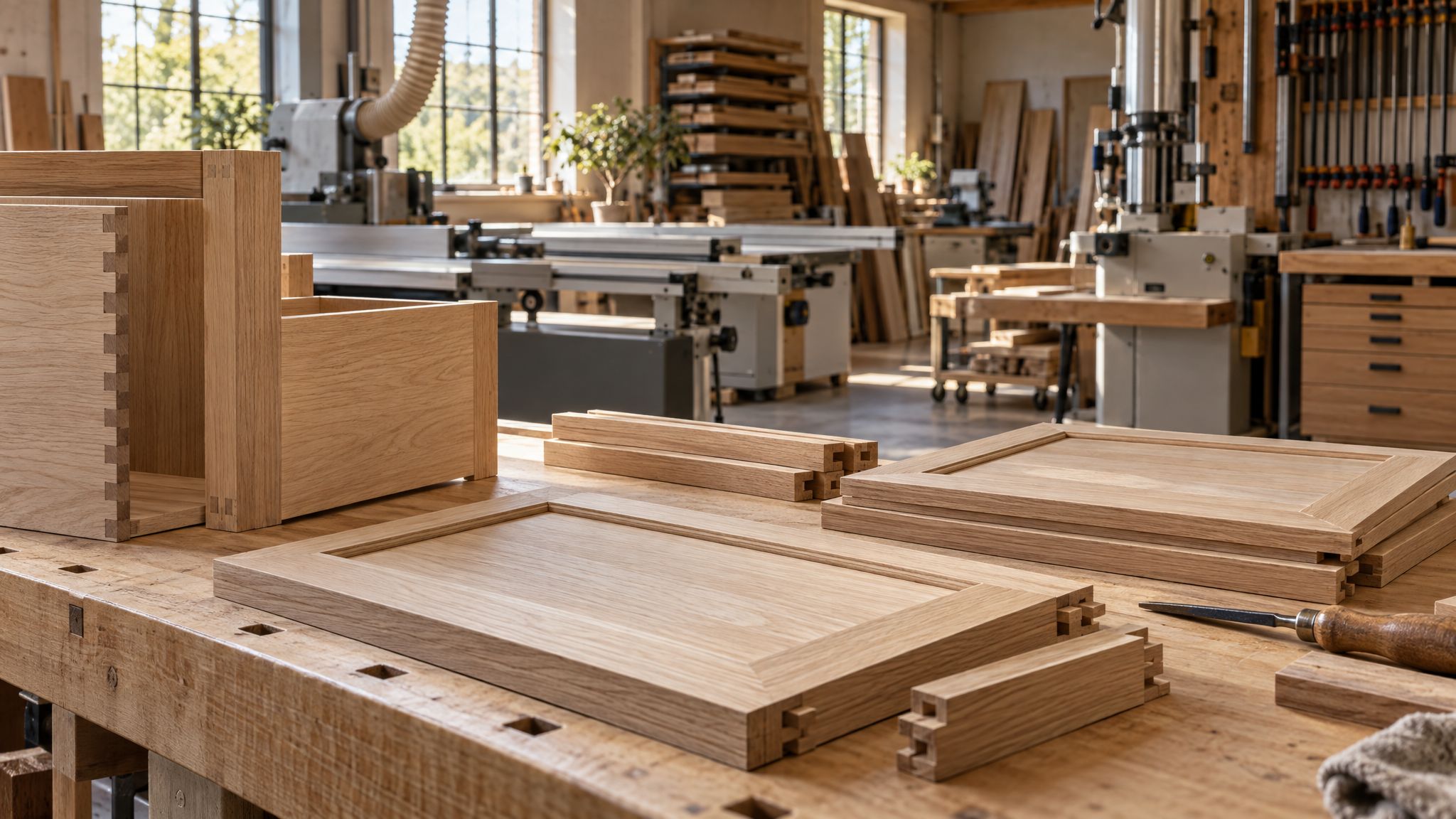
Architectural millwork — wall paneling, built-in bookcases, coffered ceilings, reception desks, staircase details, entire wood-lined rooms — asks more of a shop than a standard kitchen does. The pieces are larger, the tolerances are unforgiving, and they have to integrate with walls, ceilings, lighting, and the work of half a dozen other trades. The right shop makes it look effortless. The wrong one leaves gaps you'll see every day.
Whether you're a homeowner, designer, architect, or general contractor, here are the ten questions we'd ask before hiring a millwork shop.
1. "What kinds of architectural work have you actually built?"
Kitchen specialists and architectural millwork shops overlap, but they aren't the same. Ask for specific examples: full-height paneling, curved work, integrated lighting, large-format veneer rooms, commercial fixtures. If you're new to the category, our guide to what architectural millwork is is a useful primer.
2. "Do you produce full shop drawings, and who reviews them?"
Architectural millwork lives or dies on its drawings. Expect elevations, plans, sections, and details at large scale showing joinery, panel layout, reveals, and how everything meets adjacent finishes. On design-led projects, drawings should go back and forth with the architect or designer before fabrication. See how to read shop drawings.
3. "Do you work to AWI standards?"
The Architectural Woodwork Institute publishes quality standards — Economy, Custom, and Premium grades — that define tolerances, materials, and finish quality. Many commercial and high-end residential specifications reference them. A shop familiar with AWI grades can tell you which applies to your project and what that means in practice.
4. "How do you handle veneer selection and matching?"
For paneled rooms, how the veneer is laid out matters as much as the species. Book-matched, slip-matched, and sequence-matched panels produce very different effects, and a room-wide sequence has to be planned before a single panel is pressed. Our piece on veneer matching explains the options.
5. "How do you deal with walls and ceilings that aren't straight?"
In older buildings especially, no wall is truly flat and no ceiling truly level. Good millwork anticipates this with scribe allowances, adjustable cleats, and reveals that hide variation. Ask how they approach it — the answer tells you how experienced they really are. We cover this in why the field measure matters.
6. "What materials and substrates do you use?"
Large panels need stable cores so they don't warp; high-moisture areas need appropriate substrates; paint-grade work needs materials that won't telegraph joints through the finish. Ask what they'd use for your specific application and why.
7. "Where is finishing done, and can you match existing finishes?"
Architectural pieces often need to match existing woodwork, a designer's sample, or other trades' finishes. Ask about their spray facility, how they develop sample panels for approval, and how they ensure consistency across large runs. Our guide to custom stain matching describes the process.
8. "Who coordinates with the other trades?"
Millwork touches electrical (integrated lighting, outlets), HVAC (grilles in paneling), plumbing, flooring, and stone. Someone needs to coordinate blocking in the walls, rough-in locations, and sequencing. Ask whether the shop participates in coordination meetings and how they handle RFIs. On larger projects, this is often what separates smooth jobs from painful ones — our piece on millwork shops vs. general contractors discusses who should own what.
9. "Who installs, and how do you protect the finished work?"
Installation of architectural millwork is skilled work — panels are scribed, leveled, and fastened invisibly, and seams are aligned perfectly. Ask whether installers are part of the shop, how they sequence the install relative to painting and flooring, and how finished surfaces are protected on an active jobsite. See inside a millwork installation.
10. "Are you insured and set up for building requirements?"
In New York City, co-op and condo buildings typically require certificates of insurance naming the building and management company, and have strict rules on work hours and elevator use. Commercial projects may require additional documentation. A shop that works in these environments regularly will know the drill.
A note on pricing
Architectural millwork is usually priced per linear foot or per square foot of paneling, adjusted for species, veneer matching, finish, and complexity. Detailed, apples-to-apples quotes based on the same drawings are the only way to compare fairly. Our guide to architectural millwork cost in NYC and our cost-per-linear-foot guide give realistic ranges.
Red flags worth noticing
Be cautious of shops that won't produce drawings until after a deposit, can't show comparable work, are vague about who does finishing and installation, or quote dramatically lower than everyone else without explaining why. In architectural work, the cost of fixing a mistake after installation is almost always higher than the savings that caused it.
Questions specifically for designers and architects
If you're specifying millwork for a client, add a few more questions. How does the shop handle value-engineering requests without compromising design intent? Will they build a sample panel or mock-up for approval before production? How do they document and price changes once drawings are approved? And who is your day-to-day contact — a project manager who understands the drawings, or a salesperson relaying messages? The best millwork partners make the designer's job easier, flagging conflicts early and proposing solutions rather than simply asking questions.
Questions specifically for general contractors
For GCs, the practical questions matter most: what's the realistic production slot, what site conditions must be ready before install (drywall finished, HVAC running, flooring protected), how much lead time do they need for blocking locations, and how do they handle punch-list items? Clear answers here keep your schedule intact.
One more: ask about after-care
Architectural millwork lasts for decades, but only if it's cared for correctly. Ask the shop how the finish should be cleaned, how to handle seasonal wood movement, and whether they'll return to make adjustments after the first heating season. A shop that plans for the long life of its work is thinking the way you want your millwork partner to think.
We build architectural millwork for homeowners, designers, architects, and contractors across New Jersey, New York City, Westchester, and Connecticut. If you're planning paneling, built-ins, or a commercial fit-out, call us at (201) 281-1457 — we're glad to talk through any of these questions.