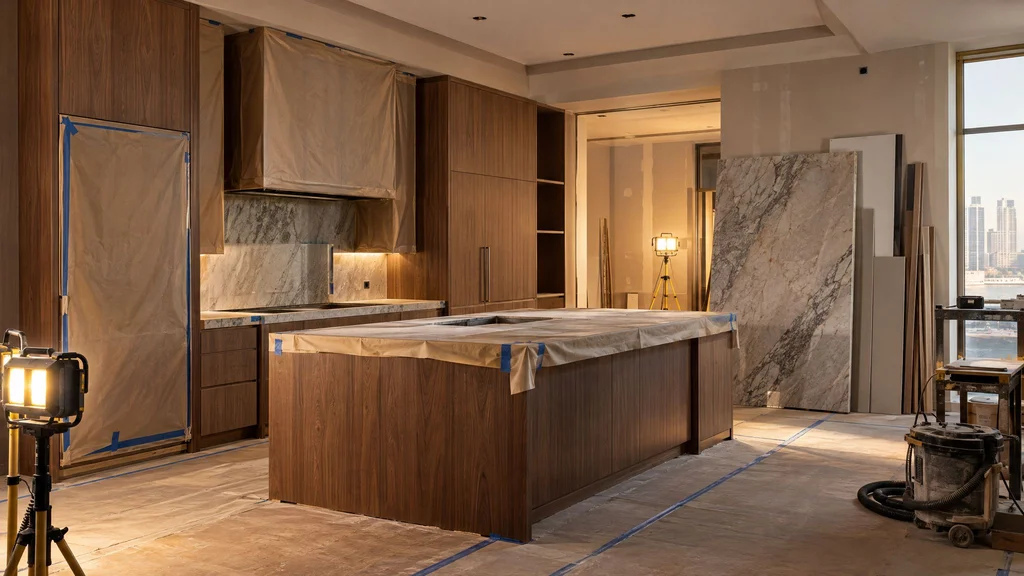
When you're renovating a kitchen, a primary suite, or a whole apartment, there's an early decision that shapes the entire project: does the cabinetry and millwork come through your general contractor, or do you hire a millwork shop directly? Both approaches can produce excellent results. They differ in who controls the design, how money flows, and who's accountable when something isn't right. Here's how we see the trade-offs, having worked both ways across hundreds of projects in New Jersey and New York City.
Option 1: Millwork through the general contractor
In this model, your GC includes cabinetry in their scope. They either have a relationship with a cabinet shop, buy from a dealer, or subcontract to whoever fits the budget and schedule. You deal with one party for everything.
Advantages: single point of contact, one contract, one schedule, and the GC coordinates sequencing between trades. For straightforward projects with standard cabinetry, this is often the simplest path.
Trade-offs: you usually have less visibility into who is actually building the cabinetry, and less direct influence over materials, construction, and finish. The GC adds their markup to the subcontracted work. And if value-engineering pressure arises mid-project, cabinetry is often where savings are found — sometimes in ways you won't notice until years later.
Option 2: Hiring a millwork shop directly
Here, you or your designer contract with a millwork shop independently. The shop handles design development, shop drawings, fabrication, finishing, and installation, and coordinates with your GC on site.
Advantages: direct relationship with the people building your cabinetry; full control over materials, construction, finish, and detailing; no GC markup on the millwork; and the ability to meet the craftspeople and approve samples yourself. For design-driven projects, this is usually how the most refined results happen.
Trade-offs: another contract to manage, and coordination between the shop and GC becomes important. That coordination is manageable — and a good shop handles most of it — but someone has to own it.
Where each model tends to fit
If your project is primarily construction with fairly standard cabinetry, running it through the GC is often efficient. If cabinetry and millwork are central to the design — a paneled library, a statement kitchen, custom closets, a fully millworked apartment — hiring the millwork shop directly generally gives you better control over the result. Many of our clients are in the second category precisely because the woodwork is the part of the renovation they care about most.
Who designs the millwork?
This is often the deciding factor. If you're working with an architect or interior designer, they'll typically want to work directly with the fabricator on shop drawings and samples — something that's much easier without a GC in the middle. We describe how that collaboration works in working with your interior designer on custom millwork. If there's no designer, a good millwork shop can lead the design itself, from layout through finish selection.
Coordination: the part that has to be solved either way
Millwork touches almost every other trade. Electricians need to know where outlets land in a bookcase back and where under-cabinet lighting runs. Plumbers need exact sink and appliance locations. Drywall needs blocking in the right places to fasten upper cabinets and heavy panels. HVAC grilles may need to pass through paneling. Stone fabricators template off installed cabinets.
When the millwork shop is hired directly, the best approach is simple: the shop provides dimensioned rough-in and blocking drawings early, attends key coordination meetings, and sequences its installation with the GC's schedule. We've written about what happens on site in inside a millwork installation.
Cost: what really changes
Hiring directly removes the GC's markup on cabinetry, which on a significant millwork package can be meaningful. However, some GCs charge a coordination fee for owner-contracted trades, so compare the full picture. More importantly, compare scope: a lower number from a GC's cabinet subcontractor may reflect different construction, materials, or finish. Our custom kitchen cost guide and millwork budget planning guide help set expectations.
Accountability when something goes wrong
With one contract through the GC, accountability is simple in theory: the GC answers for everything. In practice, a cabinetry problem still goes back to the subcontractor, just with an extra step. With a direct contract, the millwork shop is accountable for its work directly — which is usually faster to resolve. The key in either model is a clear contract. See what to look for in a custom cabinetry contract.
Scheduling
Custom millwork has a lead time of its own — often longer than the construction phase that precedes installation. That means cabinetry decisions need to be made early, sometimes before demolition begins, so fabrication can run in parallel with construction. When millwork is an afterthought in a GC-led project, it frequently becomes the item that delays the finish. Our breakdown of custom millwork lead times shows how to plan for it.
In co-ops and condos
In New York City buildings, both the GC and the millwork shop will typically need to provide insurance certificates, follow alteration agreements, and work within restricted hours and freight elevator bookings. A millwork shop experienced in these buildings makes the process smoother whether it's contracted directly or through the GC.
A hybrid approach
Many projects land in the middle: the owner or designer selects and contracts the millwork shop directly for the kitchen and key rooms, while the GC handles simpler items like laundry cabinets or basic trim. This keeps control where it matters most without complicating the entire job.
How we work
Questions to ask your GC
If you're leaning toward running millwork through your contractor, ask them who fabricates the cabinetry, whether you can visit that shop, whether you'll receive shop drawings to approve directly, and how finish samples will be handled. A good GC will be happy to answer — and the answers will tell you whether that path gives you the control you want.
We regularly work both ways — contracted directly by homeowners and designers, and as the millwork partner to general contractors. Either way, we provide full shop drawings, finish samples, rough-in coordination, and our own installation team. If you're weighing the options for a kitchen, architectural millwork, or a full renovation, call us at (201) 281-1457 and we'll help you figure out which structure fits your project.