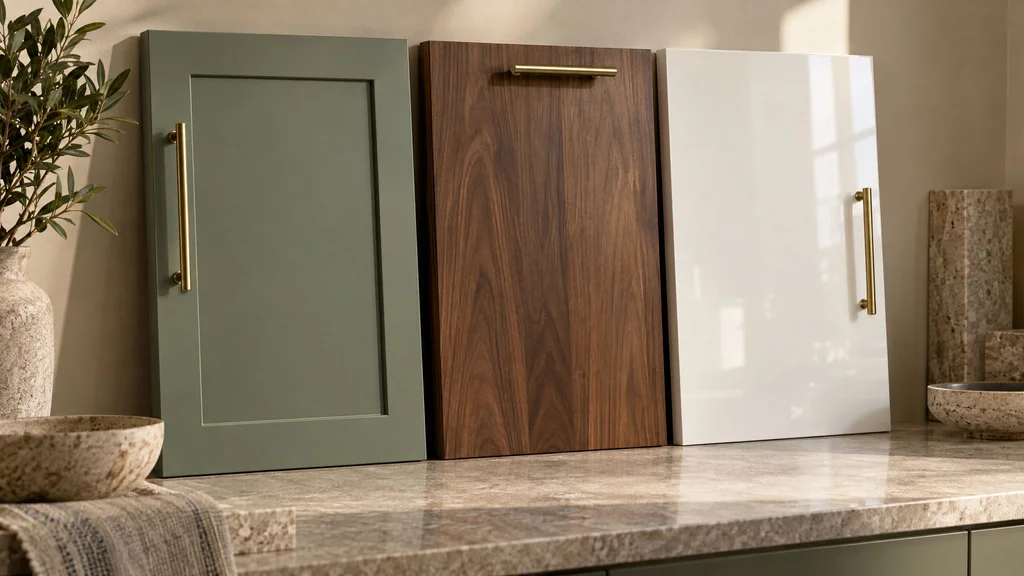
When you choose a cabinet door, you're choosing more than a color or a style — you're choosing a material system that determines how the door looks up close, how it wears, and what happens when it gets damaged. Painted doors, wood veneer doors, and thermofoil doors can look similar in photos, but they behave very differently over years of use. Here's an honest comparison.
Painted doors
How they're made
Painted doors are built from a paint-grade substrate — typically MDF for slab and center panels, and either MDF or a tight-grained hardwood like maple for frames — then primed and finished with multiple coats of paint in a spray booth. Quality painted finishes use catalyzed paints or clear protective topcoats for durability. See inside the spray booth.
Strengths
- Unlimited color choice, including custom colors matched to fabric or paint samples.
- Smooth, refined surfaces; suits Shaker, inset, and contemporary styles.
- Repairable: chips and scratches can be touched up by a professional.
Weaknesses
- Can chip on edges with hard impacts.
- Five-piece solid-wood frames can show hairline cracks at joints as wood moves; construction choices minimize this.
- Light colors show wear on high-touch areas over time.
We compare painted and stained wood in painted vs. stained cabinets.
Wood veneer doors
How they're made
Veneer doors use thin sheets of real wood laminated to a stable core, with solid wood or veneer edge banding. They're finished with stain, oil, or clear coats. Veneer makes it possible to create large, flat, stable slab doors with continuous, matched grain. See veneer matching explained.
Strengths
- The warmth, depth, and variation of real wood.
- Very stable: resists warping and movement better than solid wood slabs.
- Enables continuous grain across runs of doors.
- Can be refinished lightly, and ages naturally.
Weaknesses
- Deep gouges can go through the veneer layer and are harder to repair invisibly.
- Edges must be carefully banded and sealed, especially near water.
- Premium species and matched veneers add cost.
We compare veneer with solid wood in wood veneer vs. solid wood.
Thermofoil doors
How they're made
Thermofoil (also called rigid thermofoil or RTF) doors are made by heat-vacuum-forming a thin vinyl film over an MDF core. The vinyl can be a solid color or printed with a wood-grain pattern.
Strengths
- Lower cost than painted or veneer.
- Seamless, easy-to-clean surface with no joints.
- Consistent color with no need for finishing.
Weaknesses
- Heat sensitivity: thermofoil can peel, bubble, or delaminate near heat sources like ovens, toasters, and dishwashers — often requiring heat shields.
- Not repairable: once the film peels or tears, the door usually has to be replaced.
- Discoloration: white thermofoil can yellow over time.
- Wood-grain versions look printed up close, because they are.
Side-by-side comparison
- Look up close: veneer is real wood; painted is a smooth, rich finish; thermofoil is uniform plastic.
- Durability in a busy kitchen: painted and veneer both last decades with care; thermofoil is vulnerable to heat.
- Repairability: painted and veneer can be repaired; thermofoil generally can't.
- Cost: thermofoil is least expensive; painted and veneer cost more, with premium veneers at the top.
- Longevity: painted and veneer are long-term investments; thermofoil is typically a shorter-term solution.
Other options worth knowing
Solid wood doors — traditional five-piece doors with solid-wood frames and floating panels — offer classic character and excellent repairability, with some seasonal movement. High-pressure laminate is very durable and affordable, common in commercial settings, with a flatter look. Lacquer finishes, from matte to high gloss, apply to painted doors and offer a spectrum of looks.
Where each makes sense
- Painted: classic white or colored kitchens, Shaker and inset styles, bold custom colors.
- Veneer: warm, natural kitchens; contemporary slab doors; continuous grain; paneled rooms.
- Thermofoil: rental properties, utility rooms, and short-term budget projects away from heat sources.
Mixing materials
Many of the best kitchens mix: a painted perimeter with a veneered island, or veneered base cabinets with painted uppers. Mixing creates contrast and lets you put premium materials where they matter most. See statement kitchen island ideas.
Our take
How to tell them apart in a showroom
Look at the door edges and the back. A veneer door shows real wood grain that varies naturally and a banded edge that matches the face. A painted door has a smooth, slightly soft-feeling finish, and a paint-grade core under the edges. A thermofoil door often has a continuous wrap around the front edges with a different material on the back, and wood-grain versions repeat their pattern from door to door. Tap the surface gently — thermofoil often sounds and feels slightly plasticky.
Thinking long-term
A kitchen is typically in service for fifteen to twenty-five years or more. Over that span, repairability matters enormously. A painted door with a chip can be touched up in an afternoon; a veneer door with a scratch can be spot-repaired and refinished. A thermofoil door that has peeled near the oven usually means a replacement — and matching a single replacement door to the rest of an aged kitchen is rarely perfect. When you weigh the upfront savings of thermofoil against the full life of the kitchen, painted and veneer doors usually come out ahead in value as well as in beauty.
What about heat shields?
If thermofoil is used near appliances, manufacturers often require heat deflectors or spacers next to ranges, wall ovens, and dishwashers to prevent delamination. These add cost and complexity and can affect the look of the kitchen. Painted and veneer doors with proper finishes generally don't need them, though every door near a heat source benefits from appropriate clearances.
Whatever you choose, ask to see a door that has been in service for a few years — it tells you more than a new sample ever will.
We build painted and wood veneer doors, and for a lasting kitchen those are the materials we recommend. Both are repairable, age gracefully, and offer the refinement a custom home deserves. If you'd like to compare them side by side, we'll show you samples at our shop. Our cabinet finishes guide is a good next read. Call (201) 281-1457 to plan your custom kitchen.