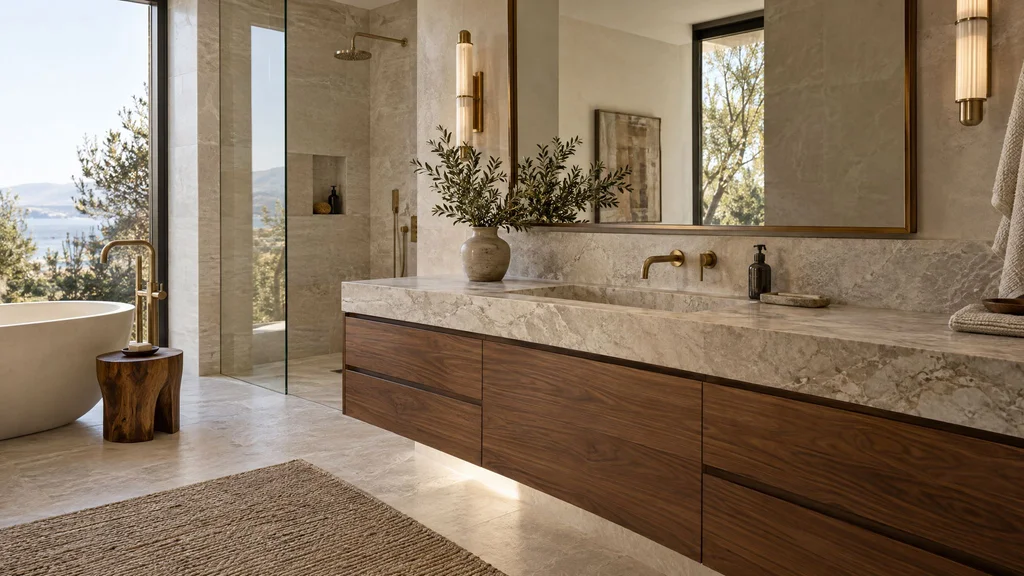
A bathroom vanity lives a harder life than almost any other piece of cabinetry in the house. It's splashed daily, exposed to steam from showers, cleaned with a variety of products, and asked to look beautiful while doing it. Wood can absolutely thrive in a bathroom — some of the most elegant vanities in the world are walnut and oak — but only when the species, construction, and finish are chosen with moisture in mind. Here's how we think about it.
What humidity does to wood
Wood absorbs and releases moisture from the air, expanding when humidity rises and contracting when it falls. In a bathroom, humidity can spike dramatically during a shower and drop quickly afterward, many times a week. Over years, that cycling stresses joints, can open seams, and causes finishes to fail if water reaches bare wood. The goal of good vanity design is to manage that movement and keep water away from raw wood. We explain the underlying physics in wood movement and custom cabinetry.
The best species for vanities
White oak
White oak is one of the best choices for bathrooms. Its closed cellular structure makes it naturally resistant to moisture — it's historically been used for boats and barrels for exactly that reason. It's stable, durable, and beautiful in natural, stained, or cerused finishes. Rift-sawn white oak is especially stable and has the straight, linear grain that suits contemporary bathrooms. See rift-sawn white oak.
Walnut
Walnut is dimensionally stable and moderately moisture-resistant, and its rich color makes a vanity feel like a piece of furniture. With a quality finish, it performs very well in bathrooms and ages gracefully.
Teak
Teak's natural oils make it exceptionally water-resistant — it's the classic choice for yachts. It's a strong option for spa-like bathrooms, though it's costly and has a distinctive look that doesn't suit every design.
Maple and cherry
Both are hard and stable, and perform well with good finishes. Maple is an excellent substrate for painted vanities; cherry deepens beautifully over time.
Species to use with caution
Softer or less stable woods, and red oak with its open pores that wick moisture, need more careful finishing. Pine and other softwoods dent easily and move more.
For a detailed comparison of species specifically for bathrooms, see our vanity wood species guide.
Veneer vs. solid wood in bathrooms
Counterintuitively, high-quality veneer over a stable, moisture-resistant core often outperforms solid wood in bathrooms. Solid wood panels move with humidity; a veneered panel on an engineered core stays flat and stable. That's why many high-end vanities, particularly those with slab doors or continuous grain, use veneer. Solid wood remains excellent for frames, edges, and traditional frame-and-panel doors built to accommodate movement. We compare the two in wood veneer vs. solid wood.
The substrate matters as much as the species
What's inside the vanity box matters. Moisture-resistant plywood or specially formulated moisture-resistant panels resist swelling if water reaches them, especially in the sink base where plumbing leaks and splashes happen. Standard particleboard swells permanently when wet — one of the most common failure points in inexpensive vanities. Our guide to cabinet construction explains the materials in more detail.
Finishes that protect
The finish is the vanity's raincoat. Durable catalyzed finishes like conversion varnish create a tough, water-resistant film. Marine-inspired finishes offer excellent protection for wood in wet environments. Hardwax oils like Rubio Monocoat offer a natural look with good water resistance and the advantage of easy spot repair, though they need occasional maintenance. What matters most is complete coverage: every surface, edge, and interior of the vanity should be sealed so moisture can't find a way in. See vanity finish options for more.
Design details that extend a vanity's life
- Seal the cutouts: sink and plumbing cutouts expose raw edges; they must be sealed.
- Protect the sink base: a moisture-resistant liner or finished interior in the sink cabinet protects against leaks.
- Consider floating vanities: lifting the vanity off the floor keeps it away from standing water and makes floors easier to clean. See floating vs. floor-standing vanities.
- Mind the toe kick: for floor-standing vanities, a sealed or elevated base resists mopping water.
- Choose the right counter overhang: a slight overhang directs drips away from the doors.
- Plan drawer interiors: finished or lined interiors are easier to clean and resist spills from toiletries.
Ventilation is part of the design
The best vanity in the world will struggle in a bathroom without adequate ventilation. A properly sized exhaust fan, run during and after showers, keeps humidity from lingering and protects all the woodwork in the room — trim and doors included. If you're renovating, it's one of the most valuable investments you can make for your millwork.
Powder rooms vs. full baths
Powder rooms see far less humidity than full baths, which opens up more options — more delicate finishes, more exotic species, and more decorative detailing. For primary and family bathrooms with daily showers, prioritize stability and protection. Our guest bathroom vanity ideas explore more expressive options for low-humidity rooms.
Caring for a wood vanity
Wipe standing water promptly, especially around the sink and faucet. Clean with a soft cloth and mild soap; avoid harsh chemicals and abrasive pads that can break down the finish. For oiled finishes, refresh with the manufacturer's maintenance product periodically. Check under the sink occasionally for slow plumbing leaks — early detection prevents damage.
What a quality wood vanity costs
Price depends on species, size, construction, finish, and details like integrated storage or double sinks. For NYC-area ranges, see our bathroom vanity cost guide.
Our recommendation
For most full bathrooms, we recommend rift-sawn white oak or walnut — often veneered on a moisture-resistant core for slab designs — with a durable catalyzed finish or a well-maintained hardwax oil, built with fully sealed interiors and edges. It's a combination that looks warm and natural and stays beautiful for decades.
We design and build custom bathroom vanities for homes across New Jersey, New York City, Westchester, and Connecticut. If you're planning a bathroom renovation, call us at (201) 281-1457 to talk through materials and see samples.