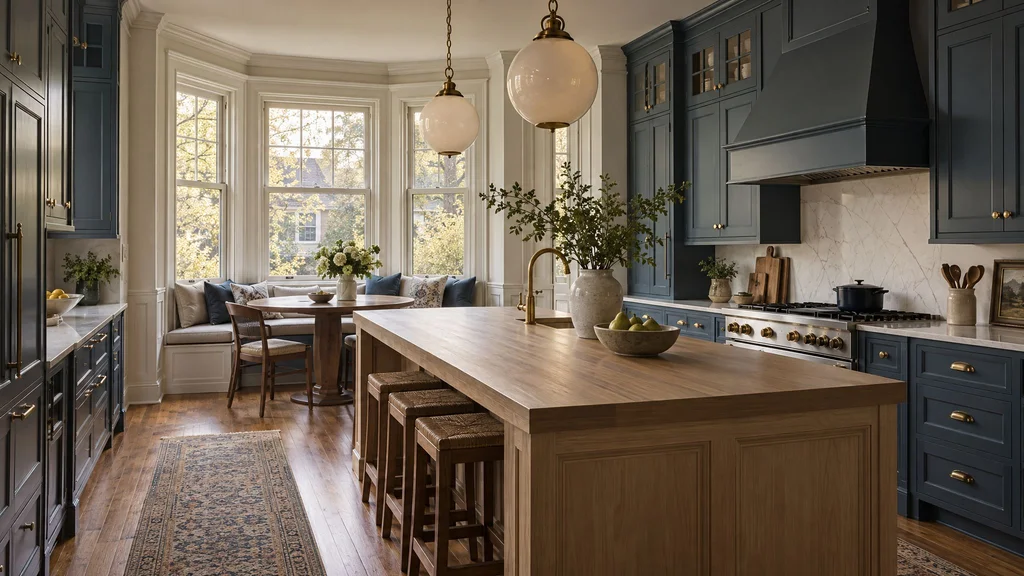
Montclair is one of New Jersey's most architecturally rich towns. Its streets are lined with Victorians, Tudor Revivals, Colonial Revivals, Arts and Crafts houses and stately early 20th-century homes, many with original woodwork, stained glass and generous proportions. Kitchens in these houses, though, were often designed for another era, renovated in the 1980s, or squeezed into rooms never intended for modern cooking. A thoughtful renovation, with custom millwork that respects the house, can give a Montclair home a kitchen that feels both original and completely contemporary in function.
Understanding Montclair's houses
Each architectural style suggests a different cabinetry language:
- Victorian: tall ceilings, bay windows, and ornate trim. Painted inset cabinetry, beaded face frames, glass-front uppers and a banquette in a bay window feel right. Deep, saturated colors suit these houses.
- Tudor Revival: dark wood, leaded glass and heavier proportions. Stained oak or walnut cabinetry, simple panel doors and iron or bronze hardware fit well.
- Arts and Crafts / Craftsman: quartersawn oak, visible joinery and honest materials. Flat-panel doors with through-tenon details, quartersawn oak and hammered copper hardware echo the style. See quartersawn lumber.
- Colonial Revival: symmetry and painted woodwork. Classic Shaker or inset doors in white or soft color, with polished nickel hardware.
Not every kitchen needs to be a period piece. A modern kitchen can sit comfortably in a Victorian if proportions are generous and materials are high-quality; see transitional kitchen design.
Common layout challenges
Older Montclair kitchens often have challenges that custom cabinetry is uniquely suited to solve:
- Too many doors: kitchens in older homes frequently have doors to the dining room, back stair, pantry, basement and porch, leaving little uninterrupted wall. Careful planning and tall cabinetry in the remaining walls maximize storage.
- Windows in awkward places: bay windows and tall sash windows limit upper cabinetry. A banquette in the bay, and open shelves between windows, turn constraints into features.
- Uneven walls and floors: houses more than a century old have settled. Scribed custom cabinetry fits them properly. See why field measurements matter.
- Chimneys and radiators: chimney breasts can frame a range, and radiators can be integrated into cabinetry with proper vented covers.
- Old butler's pantries: many houses still have one. Restoring or reinventing it as a coffee bar, bar or scullery adds huge value. See butler's pantry design.
Opening up versus keeping rooms
Many Montclair homeowners debate whether to open the kitchen to a family or dining room. Opening up improves flow and light, but can compromise the house's character and reduce wall space for cabinetry. A middle path is widening an opening with a cased archway, or adding an interior window. When a kitchen opens to a living area, the cabinetry becomes part of the room's architecture and should coordinate with other built-ins, such as bookcases or a china cabinet.
Storage that works for families
Montclair's families cook a lot, entertain often and need storage for everything from cereal to sports gear. Custom features that help include:
- A pantry wall of pull-outs and adjustable shelves, or a walk-in pantry. See custom pantry cabinet design.
- Deep drawers for pots and dishes instead of lower cabinets with doors.
- An appliance garage for the toaster, coffee machine and mixer. See hidden pantries and appliance garages.
- A drop zone and mudroom at the back door with lockers and charging. See custom mudroom design.
- A banquette with storage below. See kitchen window seats and benches.
Finishes and materials
Montclair's kitchens often embrace color. Deep blue, green and warm neutral painted cabinetry look at home in older houses, often paired with a natural wood island in white oak or walnut. Marble, soapstone and quartzite counters suit period homes; see countertop and cabinet pairing. Unlacquered brass, polished nickel or bronze hardware adds character; see hardware finishes. For durable painted finishes, see our cabinet finishes guide and cabinet paint brands.
Historic districts and permits
Parts of Montclair are designated historic districts, and exterior changes in those areas may require review by the town's Historic Preservation Commission. Interior kitchen work generally isn't subject to that review, but any change to windows, doors or additions may be. Kitchen renovations that involve plumbing, electrical, gas or structural work require building permits. Your architect or contractor will guide approvals; the millwork shop coordinates its schedule accordingly.
Timeline and budget
A kitchen renovation in Montclair typically moves from design to shop drawings, fabrication and installation. Fabrication begins after drawings and finishes are approved, and installation is timed to follow rough-in and drywall. See kitchen remodel timeline in NJ and what to expect from a custom kitchen project. For costs, read kitchen cabinet cost in NJ and custom kitchen cabinets in NJ.
Frequently asked questions
Can new cabinetry match my original trim? Yes. We can reproduce period moldings so new cabinetry integrates seamlessly with existing woodwork.
Should I keep the original butler's pantry? In most cases, yes. It's a rare feature that adds charm and function; updating it is usually better than removing it.
What color works best in a Victorian kitchen? Deep, saturated colors like navy, forest green or oxblood are historically appropriate and beautiful, but warm whites are timeless too. See white kitchen cabinets.
A planning checklist for Montclair homeowners
- Photograph and measure original trim, doors and built-ins you want new work to echo.
- Decide early whether the kitchen stays a separate room or opens to adjacent spaces.
- Note every door, window, radiator and chimney that the layout must work around.
- Choose appliances before shop drawings, since panel sizes and ventilation depend on them.
- Confirm whether any exterior work triggers historic district review.
- Plan lighting, including under-cabinet and interior cabinet lighting, alongside the millwork.
- Set aside a contingency for surprises behind old walls.
Old houses reward patience and planning. Making these decisions early keeps the design coherent and the schedule on track.
We work throughout Montclair, West Orange, Maplewood, Livingston and Little Falls. See our custom kitchens service and a related Montclair closet post.