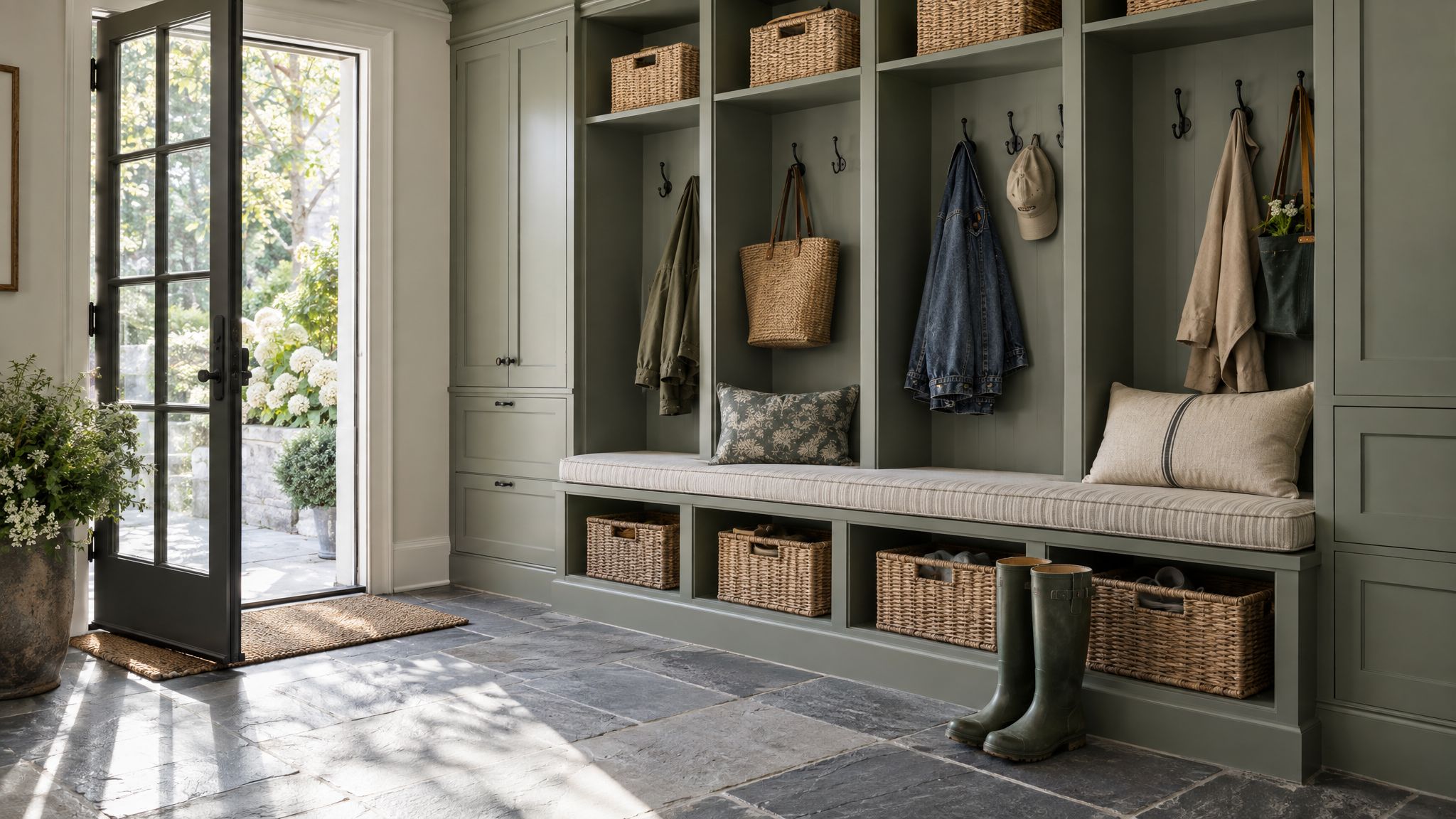
In many New Jersey homes, the front door is for guests. Everyone else comes and goes through the garage or side door — and that entry becomes the busiest room in the house. Coats, boots, backpacks, sports equipment, dog leashes, umbrellas, packages, and keys all converge in one spot. A well-designed custom mudroom turns that daily chaos into order. Here's how we approach them.
Start with how your household actually lives
Before any drawing, we ask practical questions. How many people use this entry daily? How many kids, and how old? What sports and activities come with gear? Do you have dogs? Where do packages land? Does this space double as a laundry room? Is it the path from the garage? Mudroom design is ruthlessly functional — the best designs grow from answers to these questions.
Lockers: the core of most mudrooms
Individual lockers — one per family member — give everyone a place to drop their things. A typical locker includes a coat hook or rod, a shelf above for hats and gloves, a cubby or drawer below for shoes, and sometimes a closed cabinet above for off-season items. Lockers can be open for quick access or have doors to hide clutter. Open lockers are faster for kids; doors keep the room looking calmer. Many families choose open lockers with closed storage above.
Plan locker widths generously: 15 to 18 inches minimum, and wider for teenagers and bulky winter coats. Depth of 16 to 20 inches accommodates coats on hooks.
Benches
A bench is essential for putting on and taking off boots. Bench height is typically around 18 inches. A cushion adds comfort; a durable wood or painted surface is easier to clean. The space below the bench is prime storage for shoes — open cubbies, pull-out drawers, or baskets.
Shoe and boot storage
Wet, muddy boots need somewhere to drain. Options include slatted shelves that allow air circulation, removable trays, and boot storage near a floor drain or on a waterproof floor. Keeping everyday shoes accessible and seasonal footwear stored elsewhere prevents pileups. For more shoe strategies, see closet shoe storage ideas.
Hooks, rods, and hanging storage
Hooks are fastest; rods with hangers are better for longer coats. Place hooks at different heights for adults and kids. Consider a dedicated spot for wet umbrellas and raincoats.
Drop zone and command center
Many mudrooms include a small counter or shelf for keys, mail, and phones — sometimes with a charging drawer, a bulletin board, or a family calendar. A built-in drop zone keeps these items from migrating to the kitchen counter.
Pet stations
For dog owners, a built-in pet station can include leash hooks, a drawer for treats and bags, a feeding station with recessed bowls, and even a dog bed nook built into the cabinetry. A pet wash sink or shower is a luxury many clients love.
Mudroom and laundry combinations
Combining mudroom and laundry is common and efficient: dirty clothes and sports uniforms go straight to the washer. Include a utility sink, folding counter, hanging space for drying, and storage for detergents. Stacked or side-by-side machines can be integrated behind doors.
Materials that hold up
Mudrooms take abuse, so durability matters. Painted finishes in durable, cleanable paints; hardwearing wood species; and scratch-resistant finishes all help. Protect lower surfaces that get kicked. Stone, porcelain, or slate floors withstand water and grit better than wood. For finish choices, see our cabinet finishes guide, and for material durability in humid spaces see wood movement and custom cabinetry.
Layouts for different spaces
A dedicated room
With a full room, you can run lockers along one wall, a bench and cubbies opposite, and a laundry or pet station at the end.
A hallway or garage entry
In a narrower space, a single wall of shallow lockers with a bench and hooks can be remarkably effective. Keep depth modest to preserve a clear walkway — at least 36 inches.
A closet conversion
A reach-in closet near the entry can become a compact mudroom with hooks, a bench, and shelving. See custom coat closet and entryway design.
Design details that elevate a mudroom
- Beadboard or paneled backs inside lockers for a classic look and easy cleaning.
- Integrated lighting inside lockers and over benches.
- Ventilated doors or backs to let damp coats dry.
- Name plates or labeled baskets for kids.
- A window seat–style bench with storage below. See window seats with hidden storage.
- Matching the mudroom's style to the kitchen, so the two spaces feel connected.
Cost factors
Mudroom cost depends on the number of lockers, whether doors are included, materials and finishes, integrated features like pet stations or laundry, and the complexity of the space. Open painted lockers are the most economical; wood-finished lockers with doors, integrated lighting, and specialty features cost more. For related pricing, see our custom closet cost per linear foot.
Serving New Jersey families
We've designed mudrooms for homes across Bergen, Passaic, Essex, and Morris counties — from colonials in Ridgewood and Franklin Lakes to newer builds in Wyckoff and Montclair — as well as Westchester and Connecticut. Every one is different because every family is.
Planning for the next ten years
Families change fast. The toddler who needs a low hook today will be a teenager with hockey gear in a few years. Adjustable shelves, movable hooks, and lockers that can be reconfigured let a mudroom grow with your household. We also recommend building in a little extra capacity beyond today's needs — mudrooms almost always fill up.
Keeping it looking good
A mudroom that looks tidy tends to stay tidy. Closed storage above eye level, baskets for small items, and a consistent color palette help. A durable finish and a washable bench cushion make weekly cleanup quick. And a mat system — a coarse outdoor mat and an absorbent indoor one — keeps grit from reaching the rest of the house.
If your entry has become a landing zone for everything, we'd be glad to help design a custom mudroom that works for your household. Call (201) 281-1457 to schedule a visit.