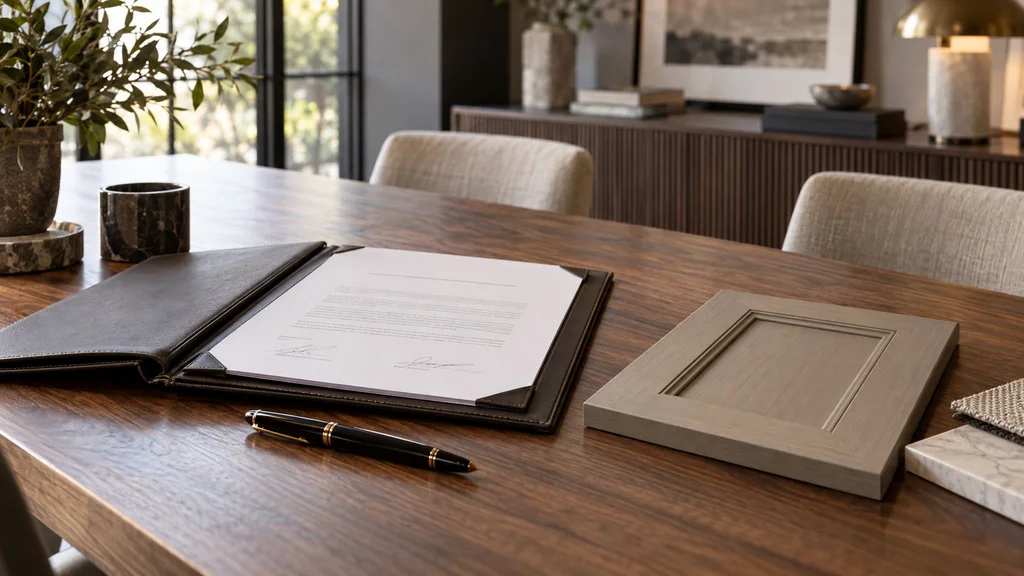
A custom cabinetry project involves real money, months of work, and dozens of decisions. The contract is what turns all of those decisions into a shared, written understanding — and it's the document you'll reach for if anything goes sideways. A good contract isn't adversarial; it simply makes expectations clear for everyone. Here's what we believe a strong custom cabinetry agreement should include, and the phrases that should prompt a follow-up question. (We're cabinetmakers, not lawyers — for significant projects, it's always reasonable to have your own attorney review any contract.)
1. A clear scope of work
The contract should state exactly which rooms and pieces are included — kitchen cabinetry, island, pantry, bar, panels, trim — and what isn't. Countertops, backsplash, appliances, plumbing fixtures, electrical work, and painting are usually by others, and saying so explicitly prevents misunderstandings. Vague language like "kitchen cabinetry as discussed" is a warning sign; you want the scope tied to specific documents.
2. Reference to drawings
The best contracts reference approved shop drawings by date or revision number. If drawings aren't final at signing, the contract should state that final scope will be defined by approved shop drawings, and describe how that approval happens. That's why careful review matters — see how to read shop drawings.
3. Materials and construction specifications
Case material and thickness, door construction, species and cut, drawer construction, and hardware brands should be written down, not just discussed. This is especially important when comparing quotes: two contracts for "custom cabinets" can describe very different products. Our list of signs of quality custom cabinetry is a useful reference for what to specify.
4. Finishes and samples
The contract should state the finish type and sheen, and describe how finish samples will be approved. Because stain and paint colors vary with species and lighting, the approved physical sample should be the standard — not a photo or a paint chip. Our guide to custom stain matching explains why.
5. Price and what it includes
Is the price fixed or estimated? Does it include delivery, installation, hardware, and taxes? Are there allowances — for example, a hardware allowance that could change the total depending on your final selection? Clear pricing prevents the most common post-signing surprises.
6. Payment schedule
Custom work typically involves a deposit at signing to secure the production slot and fund design, followed by payments tied to milestones — often drawing approval or start of fabrication, delivery, and completion of installation. Milestone-based schedules protect both sides: the shop is funded as it commits materials and labor, and you pay as work progresses. Be cautious of any contract requiring nearly the full amount before fabrication begins.
7. Change orders
Changes happen. A good contract describes how they're requested, priced, approved in writing, and how they affect schedule. Changes after drawing approval — especially after fabrication has started — can have real costs, and the contract should say so plainly.
8. Timeline and what affects it
Expect an estimated timeline rather than a guaranteed date, along with the conditions that affect it: timely approvals, site readiness, and material availability. See our breakdown of custom millwork lead times for realistic ranges.
9. Site conditions and responsibilities
Installation depends on the site being ready: drywall finished, blocking installed, plumbing and electrical roughed in to the drawings, and a clear, secure workspace. The contract should state these requirements and what happens if the site isn't ready on the scheduled install date. In NYC buildings, it should also address insurance certificates, building rules, and elevator reservations.
10. Installation details
Who installs? What's included — scribing, trim, filler panels, hardware installation, final adjustments? What's excluded — for example, removing old cabinetry, or patching and painting walls afterward? These details are easy to agree on in advance and frustrating to discover later. For a sense of what's involved, read inside a millwork installation.
11. Warranty
A good warranty covers workmanship and materials for a defined period, and explains what isn't covered. Honest contracts address natural wood behavior: solid wood expands and contracts with humidity, color changes with light exposure, and minor seasonal movement is normal rather than a defect. See wood movement and custom cabinetry for why.
12. Punch list and completion
Define what "complete" means. Typically, after installation there's a walkthrough to create a punch list of small adjustments, which the shop completes promptly. The final payment is usually tied to substantial completion, with a reasonable mechanism for any remaining items.
Language that deserves a question
- "Materials as needed" or "standard materials" without definition.
- "Timeline to be determined" with no framework.
- No mention of drawings or samples.
- Installation described only as "install cabinets."
- A warranty that excludes nearly everything.
A contract is a sign of how a shop works
A detailed, clearly written contract usually reflects a shop that's organized and experienced — the same qualities you want in the people building your cabinetry. If a shop resists putting things in writing, that tells you something too. It's one of the questions worth asking any cabinetmaker.
Our approach
Comparing contracts from different shops
When you're choosing between shops, lay the contracts side by side and compare line by line: case material, drawer construction, hardware brands, finish type, what installation includes, payment timing, and warranty terms. Differences in these lines usually explain differences in price far better than the bottom number does. If one contract is much shorter and vaguer than the others, ask the shop to add the missing specifics before you decide. A shop confident in its work will happily put its standards in writing, and you'll have a much clearer basis for comparison.
Every project we take on is governed by a written agreement tied to approved shop drawings, with milestone payments, a clear change process, and our own installation team. We're always happy to walk clients through it line by line before they sign. If you're planning a custom kitchen or millwork project and want to see how we structure it, call us at (201) 281-1457.