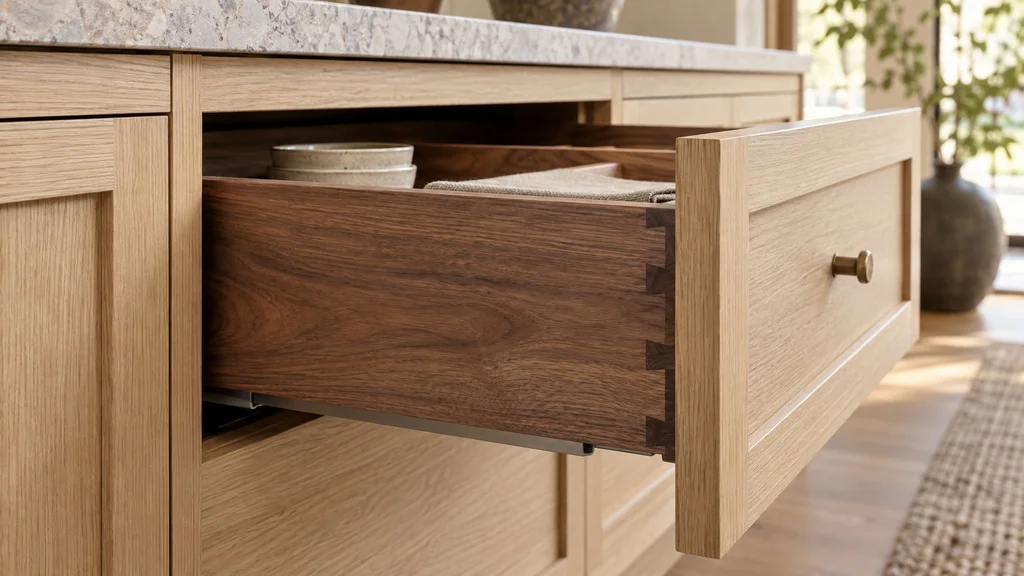
Every cabinet looks good on install day. The difference between quality cabinetry and merely expensive cabinetry shows up in year three, when a drawer bottom sags, a painted door cracks at its joint, or a hinge starts to droop. The good news: most of those future problems are visible today if you know where to look. Here are the nine details we'd check on any cabinet — ours or anyone else's — and the red flags that tell you to keep looking.
1. What the boxes are made of
Open a base cabinet and look at the sides, bottom, and back. Quality cases are built from cabinet-grade plywood or high-density veneered panels at least ¾ inch thick on the sides, with a substantial back — not a thin sheet of hardboard stapled on. Plywood holds fasteners better, resists moisture far better than particleboard, and stays flat over time. This matters most under the sink, around the dishwasher, and anywhere near water.
Red flag: particleboard sink bases, or edges where you can see the crumbly core through chipped banding.
2. How the drawers are built
Pull a drawer all the way out and look at the corners. Dovetail joints — interlocking fingers of wood — are the gold standard because they mechanically resist the pulling force a drawer sees thousands of times a year. Drawer sides should be solid hardwood or quality plywood, and the bottom should be captured in a groove on all four sides rather than stapled to the underside.
Red flag: stapled corners, drawer bottoms nailed from below, or drawer boxes made of thin melamine.
3. The slides
Quality drawers run on full-extension, soft-close, undermount slides — mounted under the drawer where you can't see them, carrying heavy loads smoothly, and letting you reach the very back. Load a drawer with a stack of plates and open it: it should glide and close gently without sagging.
Red flag: side-mounted three-quarter-extension slides, or slides that rack when you pull from one corner.
4. The hinges
Look for concealed European hinges from reputable manufacturers, with soft-close and three-way adjustment. Adjustability matters because wood moves and houses settle; a good hinge lets an installer bring every door back into perfect alignment years later with a screwdriver.
5. How the doors are constructed
For painted doors, quality shops use stable materials and construction methods that minimize movement at the joints, because the classic failure of painted cabinetry is a hairline crack where the stile meets the rail. For stained doors, look at grain selection — well-made doors have grain that runs consistently and, on slab doors, flows from one door to the next. Our guide to painted, veneer, and thermofoil doors explains how each type performs.
6. Reveals and alignment
Stand back and look at the gaps between doors and drawers. On quality work, they're consistent — typically ⅛ inch or less — and perfectly parallel, with tops of doors aligned across a run. Uneven reveals usually signal either imprecise fabrication or a rushed install. This is one of the places where the precision of modern machinery and the care of the installer both show. We explain that combination in CNC vs. handmade cabinetry.
7. The finish, up close and at an angle
Look at the finish under raking light — a flashlight held nearly parallel to the surface. A quality finish is smooth and even, with no orange-peel texture, drips, dust nibs, or dry spots. Check inside edges and the backs of doors: a shop that finishes the parts you don't see is a shop that didn't cut corners on the parts you do. Our cabinet finishes guide covers the main finish types, and how custom cabinets get their finish shows the process.
Red flag: unfinished door backs, raw edges inside cabinets, or a finish that feels rough when you run a hand across it.
8. How the cabinetry meets the room
Where cabinets meet walls, ceilings, and floors, quality work is scribed — cut to follow the actual contour of the wall — so there are no uneven gaps filled with caulk. End panels are finished, fillers are minimal and intentional, and crown and toe kicks run straight even when the ceiling and floor don't. That fit begins with a proper field measure.
9. The interiors
Open everything. Are shelf edges banded? Are shelves thick enough not to bow under dishes? Are interior surfaces finished and easy to clean? Are drawer interiors sized to what you'll actually store? Thoughtful interiors — pull-outs, dividers, drawers-within-drawers — are a sign that someone designed the cabinetry around how you live, not just how it looks.
Red flags that show up before you sign
Some warning signs appear before a single cabinet is built. Be wary of a shop that won't provide shop drawings, can't tell you who builds the boxes or who installs them, is vague about materials and hardware brands, or quotes dramatically below other firms without explaining why. Each of those usually traces back to one of the nine details above. Our list of questions to ask a custom cabinetmaker helps surface them early.
Why these details matter more than the door style
Door style and color are what you notice first, and they're what show up in photos. But the details above are what determine whether a kitchen still feels solid and precise after fifteen years of daily use. A beautiful door on a weak box is still a weak cabinet. The best way to evaluate quality is to visit a shop, open finished work, and compare — which is also the best way to understand the real difference between custom, semi-custom, and stock cabinetry.
A simple test you can do in any showroom
Next time you're looking at cabinetry, do three things: pull a loaded drawer out fully and let it close on its own; open a door and push gently on its outer corner to see if it flexes; and run your hand along a painted edge. Quality cabinetry passes all three without a second thought. Then ask to see the inside of a sink base. You'll learn more in two minutes than from any brochure.
Everything we build for our custom kitchens, closets, and vanities is held to these standards. If you'd like to see them in person, visit our shop in Little Falls, New Jersey, or call (201) 281-1457.