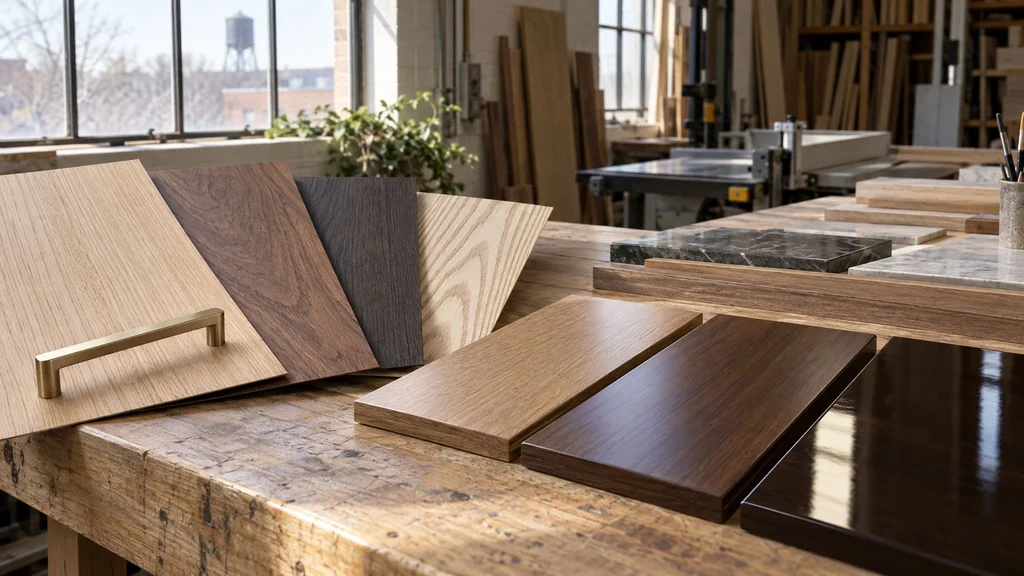
Every custom millwork project comes down to three decisions that are made early and are expensive to reverse: the species, the way the wood is cut or veneered, and the finish on top. Choosing wood for custom millwork is less about picking a favorite color from a sample chip and more about understanding how a material behaves in a New York apartment with steam heat in January and 70 percent humidity in July, what it costs relative to the alternatives, and how it will look ten years after install.
This guide is for homeowners, architects, designers and restaurant owners about to make those decisions with a millwork shop. It covers species, cut, veneer versus solid, paint-grade construction, finish systems, color, wood movement in the NYC climate, and what each choice does to the per-linear-foot numbers we publish, drawing on what we build in our Little Falls shop. Where we have a deeper post, we summarize and point you there.
1. How to think about materials before you pick one
Clients usually arrive with a photo. It tells us the look, but not the five things that decide whether that look is achievable and durable in your room:
- Appearance: grain figure, color, and whether the species takes stain evenly.
- Stability: how much the wood moves between a dry winter and a humid summer.
- Cost: the lumber price, plus yield, finishing labor and matching labor on figured species.
- Finish behavior: some woods blotch under stain (cherry, maple), some fight film finishes (oily teak).
- Availability: wide rift white oak, long clear walnut and matched veneer flitches are not stocked at a lumberyard; material lead time is part of your project lead time.
Most failures we are called in to look at started as a beautiful sample that won on appearance alone.
2. The species we use most and why
Rift and quartersawn white oak
White oak is the backbone of luxury millwork in New York. It is hard (1,360 Janka), finishes smoothly, takes any finish from a pale waterborne clear to cerused or fumed, and when rift- or quartersawn it is one of the most stable domestic hardwoods available. Our guide to rift-sawn white oak goes deeper.
Walnut
Walnut is our second most requested species. It is softer than oak (1,010 Janka), and its color is not fixed: fresh walnut has purple and gray undertones that fade to a warm honey-brown over three to five years. If you want it to stay dark, plan on a toner. Our comparison of walnut versus white oak covers the usual kitchen decision.
Hard maple, cherry and ash
Hard maple is the hardest domestic we use regularly (1,450 Janka), used clear for pale modern work and for drawer boxes. Cherry darkens from salmon-pink to deep reddish brown within a year. Ash reads as a straighter, blonder oak, nearly as hard and less expensive.
Red oak, sapele, teak and the exotics
Red oak fell out of favor for its pink cast and 1990s builder associations, but most pre-war Manhattan floors are red oak, which matters when matching. Sapele gives mahogany’s ribbon stripe at a fraction of the cost. Teak is our pick when a vanity or shower bench gets wet daily; its oils resist water but fight film finishes, so it is left oiled. Some looks exist only as veneer: fumed oak, bog oak pulled from peat beds after centuries underground, and reconstituted veneers that engineer a perfectly repeating grain, often on an eight-week lead time.
| Species | Janka | Movement (rift/quartered) | Color over time | Best uses | Relative cost index |
|---|---|---|---|---|---|
| White oak, rift/quartersawn | 1,360 | Low | Warms slightly | Kitchens, paneling, vanities | 1.0 (baseline) |
| Walnut | 1,010 | Low–moderate | Lightens to honey-brown | Kitchens, libraries | 1.15–1.3 |
| Hard maple | 1,450 | Moderate | Yellows noticeably | Clear modern work | 0.85–0.95 |
| Cherry | 950 | Low | Darkens sharply in year one | Traditional kitchens | 0.95–1.1 |
| Ash | 1,320 | Moderate | Mild yellowing | Scandinavian interiors | 0.8–0.95 |
| Red oak | 1,290 | Moderate | Pink cast warms | Stained traditional | 0.75–0.9 |
| Sapele | 1,410 | Low | Reddens and darkens | Formal paneling, bars | 1.0–1.2 |
| Teak | 1,070 | Very low | Golden to deeper brown | Wet rooms | 1.5–2.0 |
| Poplar (paint-grade) | 540 | Moderate | Hidden under paint | Painted frames, moldings | 0.6–0.8 (painted) |
| Fumed, bog oak, exotic veneers | Varies | Low (MDF core) | Varies | Feature walls | 1.3–2.5+ |
The index is for finished cabinetry, where shared finishing and installation labor narrows the gap between raw lumber prices.
3. Cut matters more than species
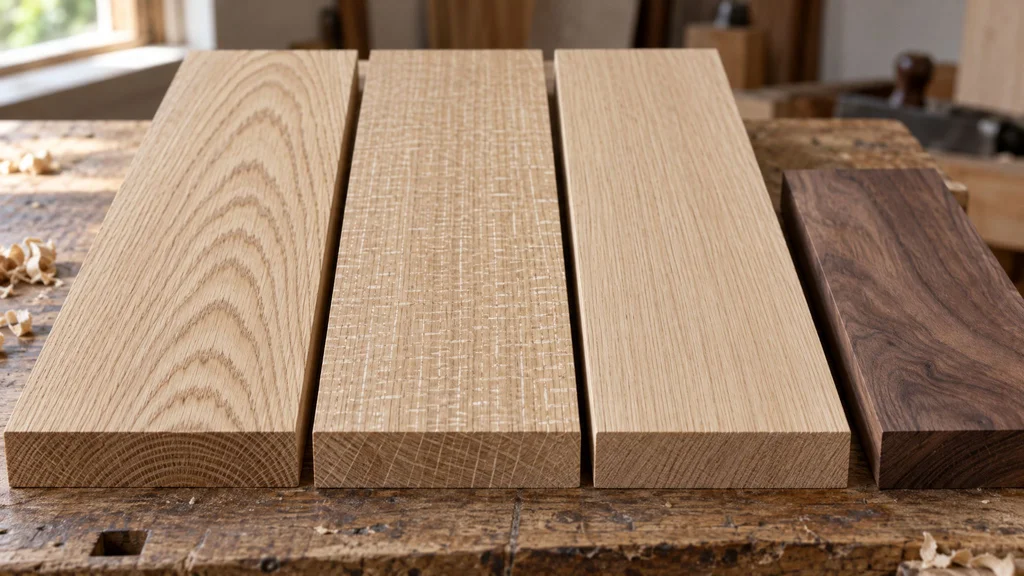
Two white oak kitchens can look like different woods depending on how the log was sawn. Plainsawn boards are cut tangent to the growth rings and show cathedral arches; it is the cheapest cut. Quartersawn boards are cut radially, show straight grain plus the silvery ray fleck white oak is known for, and move about half as much. Riftsawn boards are cut at roughly 30–60 degrees to the rings, giving the straight, quiet, fleck-free grain most designers mean when they say “white oak.” Rift is the lowest-yield cut and costs 40–70 percent more than plainsawn from the same log.
Cut also sets grain direction: vertical grain reads tall and calm; horizontal grain reads modern but must line up across every door and drawer in the run, cut from the same leaves in sequence. More in quartersawn vs. riftsawn vs. plainsawn. What goes wrong: a client approves a rift sample, the shop runs short and fills in with plainsawn on the end panels, and the kitchen has two personalities. We buy the whole job’s material at once, from one source, before we cut.
4. Veneer versus solid wood
The idea that veneer is the budget option and solid the premium one is often reversed in architectural millwork. Veneer on a stable core is how you get a 36-inch-wide slab door that stays flat, grain that flows across twelve feet of paneling, or a curved walnut reception desk. Solid wood is right for frames, edges, moldings and anything that will be shaped. We go deeper in wood veneer vs. solid wood.
Cores, thickness and edges
MDF cores are the flattest and best for slab doors; veneer-core plywood is lighter and holds screws better for boxes. Standard veneer is sliced at roughly 1/42 inch; we buy thicker stock (1/32 or 1/16) when a job will see hard use. Edges are solid hardwood, mitered so no end grain shows.
Matching
Veneer leaves come off the log in sequence, and how they are laid up changes everything. Book matching flips alternate leaves like pages for a mirrored figure; slip matching slides them side by side for a calmer repeating grain (our default for rift oak); sequence matching carries that order across every door, drawer and panel so a room reads as one surface. See veneer matching explained. On repairability: a dent in solid wood can be steamed out and a dent in veneer cannot, but a warped solid door is replaced while veneered doors rarely warp.
5. Paint-grade construction
Painted cabinetry is the largest category we build, and the material under the paint is chosen for stability. Slab doors and flat panels are MDF, which is dead flat and does not move. Door and face frames are poplar or hard maple. In five-piece doors the center panel is MDF, never solid wood, because solid panels shrink in a steam-heated winter and open a hairline crack in the paint at every joint.
That crack is the most common complaint we hear about painted kitchens built elsewhere. The causes are solid panels, frames glued up from stock that was never acclimated, and finish applied too thick to flex. Our prevention: MDF panels, a stable frame species, two weeks of acclimation, and a catalyzed finish in controlled coats. One-piece routed MDF doors have no joints to crack at all; five-piece doors are for Shaker and traditional profiles where the shadow line is the point. See painted vs. veneer vs. thermofoil doors.
6. Finishes explained
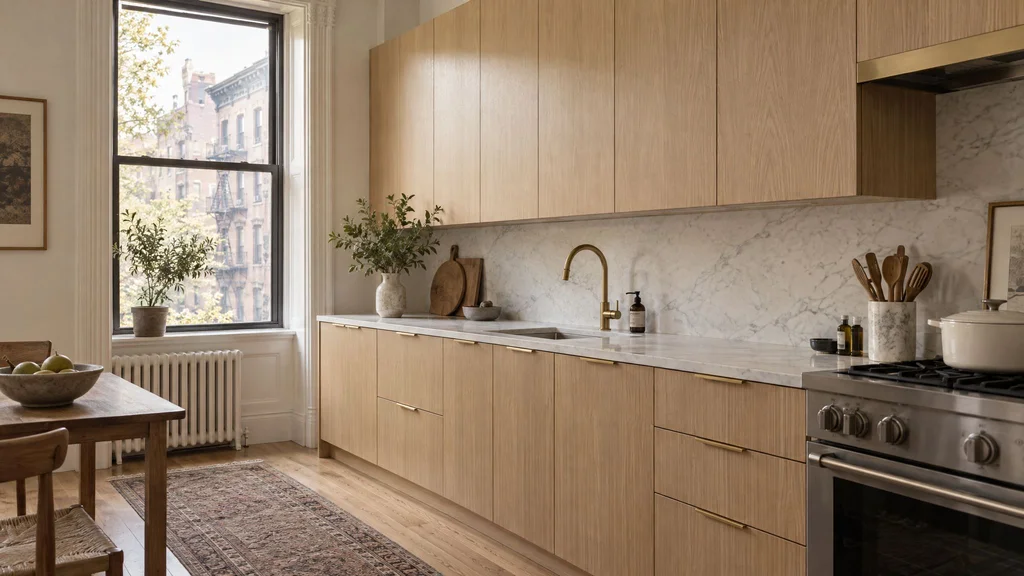
The finish decides how the species looks, how it ages, and whether a scratch is a ten-minute fix or a door replacement; our kitchen-focused paint, stain or lacquer guide is a good companion. All but the hardwax oils are sprayed in our booth.
The systems we use
- Pre-catalyzed lacquer: fast and easy to touch up because new coats melt into old ones, but the least durable against water and chemicals. We use it for closet interiors and bedroom built-ins.
- Conversion varnish: a two-component finish that cures into a hard, chemically resistant film. Our standard for painted kitchens and most clear-coated hardwoods; damaged doors come back to the shop for repair.
- 2K polyurethane: harder still, with the best resistance to water, alcohol and cleaning products; the aliphatic versions do not yellow. We use it under high-gloss work, on bar tops and in bathrooms.
- Waterborne finishes: the better acrylic-urethanes now approach conversion varnish in durability with a fraction of the VOCs, and they stay water-clear, which keeps white oak pale and ash blond.
- Hardwax oils such as Rubio Monocoat and Osmo Polyx-Oil: in-the-wood finishes, not films. The most natural matte surface, repairable with a rag, almost no VOCs, but less resistant to standing water, so they want a client who will maintain them. See our Rubio Monocoat guide.
- Stains, toners and oak treatments: dye stains penetrate evenly, pigment stains emphasize the grain, and toners are tinted clear coats that shift color without blotching. Cerusing (liming) fills oak’s open grain with a contrasting paste, fuming darkens it chemically, and bleaching strips the amber for a driftwood tone.
- High-gloss: a polyester or 2K primer block-sanded dead flat, multiple gloss topcoats, then wet-sanding and polishing to a mirror. It roughly doubles finishing labor and shows every flaw in the substrate, which is why it sits on MDF. See our high-gloss lacquer kitchen guide.
| Finish | Durability | Repairability | Look | VOC | Best uses | Cost index |
|---|---|---|---|---|---|---|
| Pre-catalyzed lacquer | Moderate | Excellent | Classic, slightly warm | High | Closet interiors, bedrooms | 1.0 |
| Conversion varnish | High | Fair (shop repair) | Clear or painted, any sheen | High | Painted kitchens, stained hardwoods | 1.2 |
| 2K polyurethane | Very high | Fair | Clear, non-yellowing | Moderate–high | Baths, bars, high-gloss base | 1.3–1.5 |
| Waterborne acrylic-urethane | High | Good | Water-clear | Low | White oak, ash, low-VOC projects | 1.1–1.2 |
| Hardwax oil (Rubio, Osmo) | Moderate | Excellent (spot repair) | Matte, in-the-wood | Very low | Oak, walnut, paneling, furniture | 1.0–1.2 |
| High-gloss polyester / 2K | Very high | Poor (refinish panel) | Mirror | High | Statement kitchens, dressing rooms | 2.0–3.0 |
Sheen
Sheen is measured by how much light a surface reflects at a 60-degree angle: flat or matte roughly 5–15 units, satin 25–40, semi-gloss 50–70, gloss 85 and up. Satin is the safe default for painted kitchens because it hides fingerprints and sanding marks; matte reads more current but shows hand oil on frequently touched doors; gloss is unforgiving of everything.
7. Color: matching, samples and how wood changes
Most color problems trace back to a sample approved under the wrong light. A stain viewed under showroom fluorescents looks different under 2700K warm LEDs at home. We make samples on the specified species and cut, at least 8 by 10 inches, and ask clients to view them in the room, next to the floor and countertop. For matching existing pieces, see custom wood stain matching.
Then the wood keeps changing. Walnut lightens, cherry darkens, white oak and maple yellow under oil-based clears and UV. UV inhibitors slow this but do not stop it, and nothing evens out the door that faces the window. Waterborne clears and hardwax oils age more gracefully than heavy toners that lock a color on day one. Hardware follows the same logic: unlacquered brass and its patina suit walnut and cerused or fumed oak, satin brass holds against pale rift oak, blackened steel sharpens ash and bleached oak, and nickel or chrome belongs with painted work. Keep it to two metal finishes per room.
8. Wood movement and the NYC climate
New York and northern New Jersey are hard on wood. A pre-war apartment with steam radiators can sit at 15–20 percent relative humidity in February and 60–70 percent in August. A 12-inch-wide plainsawn white oak panel can change width by a quarter inch or more across that swing. Rift and quartersawn boards cut that in half, and veneer on MDF reduces it to almost nothing.
Our standard practice: lumber is acclimated in the shop for two weeks and metered before milling, targeting 6–8 percent moisture content. Solid panels float in their frames with a 1/16-inch gap each side and are never glued. Long solid tops get slotted fasteners, and expansion gaps at walls hide behind scribe moldings. What fails is predictable: glued-in panels split, wide solid slab doors cup, and edge-glued tops fastened rigidly tear their own screws out. More in wood movement in custom cabinetry.
If a shop tells you their solid wood doesn’t move, ask what they do in February. Every piece of wood in the city moves; the difference is whether the millwork was designed to let it.
9. What species and finish do to the price
Our published ranges for custom kitchens in NYC run $1,200–$4,500 per linear foot, walk-in closets $700–$3,500, and built-in bookcases $600–$3,000. A mid-range painted MDF kitchen with conversion varnish typically lands at $1,800–$2,800 per linear foot; rift white oak veneer adds roughly 15–25 percent, and walnut adds another 15–30 percent on top of white oak. More in walnut kitchen cabinets in NYC.
| Material and finish choice | Compared with | Typical effect on price per LF |
|---|---|---|
| Painted MDF/poplar, conversion varnish, satin | Baseline (mid-range custom kitchen) | $1,800–$2,800/LF |
| Rift white oak veneer, waterborne or hardwax oil | Painted baseline | +15–25% |
| Solid rift white oak five-piece doors | Veneered white oak slab doors | +10–20% |
| Walnut veneer, sequence matched | Rift white oak | +15–30% |
| High-gloss 2K or polyester on MDF | Satin painted | +25–40% |
| Cerused, fumed or bleached oak | Clear white oak | +8–15% |
| Bog oak, fumed eucalyptus, exotic veneers | Rift white oak | +30–60% |
| Teak (wet-room vanities) | White oak vanity | +40–80% |
Two patterns: finish labor outweighs material cost on nearly every job, so a complex finish on a cheap species costs more than a simple finish on a costly one; and matching is labor, so a sequence-matched walnut room costs more than the same walnut in random leaves.
10. Sustainability and sourcing
Domestic hardwoods such as white oak, walnut, maple, cherry and ash are the easiest sustainable choice: managed North American forests, a few hundred miles of transport, and FSC-certified stock available at a modest premium. Imported species carry more questions; we ask for chain-of-custody documentation on sapele, mahogany and teak. Reclaimed material is inconsistent and labor-intensive to mill, so we treat it as a feature rather than a whole kitchen. Waterborne systems and hardwax oils cut VOCs where a LEED or WELL target requires it. There is a longer list of questions in sustainable wood sourcing in custom millwork.
11. Material mistakes we see, and the fixes
- Choosing walnut for its day-one color. Fix: approve a sample that has sat in a window for a month, or ask for a toner.
- Specifying plainsawn oak to save money, then expecting a rift look. Fix: decide the cut on the drawing, not at the lumberyard.
- Solid wood slab doors over 12 inches wide. They cup. Fix: veneer on an MDF core with solid edges.
- Solid center panels in painted doors. Cracked paint at every joint by the second winter. Fix: MDF panels and a stable frame species.
- Hardwax oil in a family kitchen no one intends to maintain. Fix: a matte waterborne clear gives most of the look with no upkeep.
- Approving color from a 2-inch chip. Fix: full-size samples in the room, under its lighting.
- Mixing veneer suppliers mid-project. Two flitches of “rift white oak” rarely match. Fix: buy the whole job from one flitch, with 15 percent overage.
- Teak or other oily exotics under a film finish. Adhesion fails within a year. Fix: an oil finish, or a different species.
- Skipping acclimation to hit a deadline. Fix: build two weeks into the schedule; there is no fix after the fact.
12. How to choose with your millwork shop
The first material meeting goes better when you bring the room with you:
- Inspiration images, with a note on what you like in each (the color, the grain direction, the sheen).
- A sample of your existing or planned flooring, and photos of furniture the millwork must live with.
- Countertop and tile samples or spec sheets.
- The lighting plan or the bulbs you use, so we can match sample viewing.
- How the room is used: kids, pets, a cook who deglazes with wine every night.
- For co-ops and condos, the alteration agreement, since some buildings restrict finishing on site.
Expect the shop to come back with physical samples, usually two rounds, and a drawing that names the species, cut, veneer match, core, finish system and sheen for every visible surface, on the shop drawings you sign rather than in an email. A custom kitchen then takes 10–16 weeks from approved shop drawings to installation, and special veneers can add two to four weeks up front.
Frequently asked questions
What is the best wood for custom kitchen cabinets?
For most of our clients it is rift or quartersawn white oak: hard, stable, available, and happy under nearly any finish. Walnut is the choice when a darker, warmer wood is wanted and the client accepts that it will lighten. Painted MDF and poplar remain the most durable paint-grade option.
Is veneer lower quality than solid wood?
No. In architectural millwork, veneer on a stable core is the higher-performance choice for wide doors, long panel runs and curved work, because it stays flat and can be grain-matched across a room. Solid wood is better for frames, edges and parts that will be shaped. Quality lives in the core and the edges, not the word.
Why did the paint crack at the joints of my cabinet doors?
Almost always because the center panel or frame is solid wood that shrank during a dry, steam-heated winter and pulled the paint film apart at the joint. The fix in new work is an MDF center panel, a stable frame species, two weeks of acclimation, and a catalyzed finish in thin coats. Filled cracks tend to return.
Does walnut really get lighter over time?
Yes. Fresh walnut has purple and gray undertones that fade toward a warm honey-brown over three to five years, faster in direct sun. If you want walnut to hold a darker tone, specify a toner or a UV-inhibiting clear, and approve a sample that has had some light exposure.
Which finish is most durable for a kitchen?
Conversion varnish and 2K polyurethane are the most durable film finishes we spray, resisting water, alcohol and cleaning chemicals far better than pre-catalyzed lacquer. Hardwax oils such as Rubio Monocoat are the most repairable and natural-looking, but they need periodic maintenance and more care around standing water.
How much more does walnut cost than white oak?
On finished cabinetry, typically 15–30 percent more for the same design. Raw walnut lumber can cost twice as much as white oak, but finishing, matching and installation labor are the same. Our published library-wall ranges illustrate it: white oak veneer built-ins at $1,400–$2,600 per linear foot against walnut veneer at $1,800–$3,000 and up.
Can you match new millwork to my existing floors or furniture?
Yes, if we have a physical sample. We match species and cut first, then build color with dye, toner and the clear coat, and we view samples under the room’s own lighting. A perfect match on day one will drift as the two surfaces age at different rates, so we aim for a deliberate near-match.
If you are weighing species, cuts or finishes for a project in New Jersey, New York City, Westchester or Connecticut, we are glad to put real samples in your hands and walk through the trade-offs. See our custom kitchen services or call (201) 281-1457 to start the conversation.