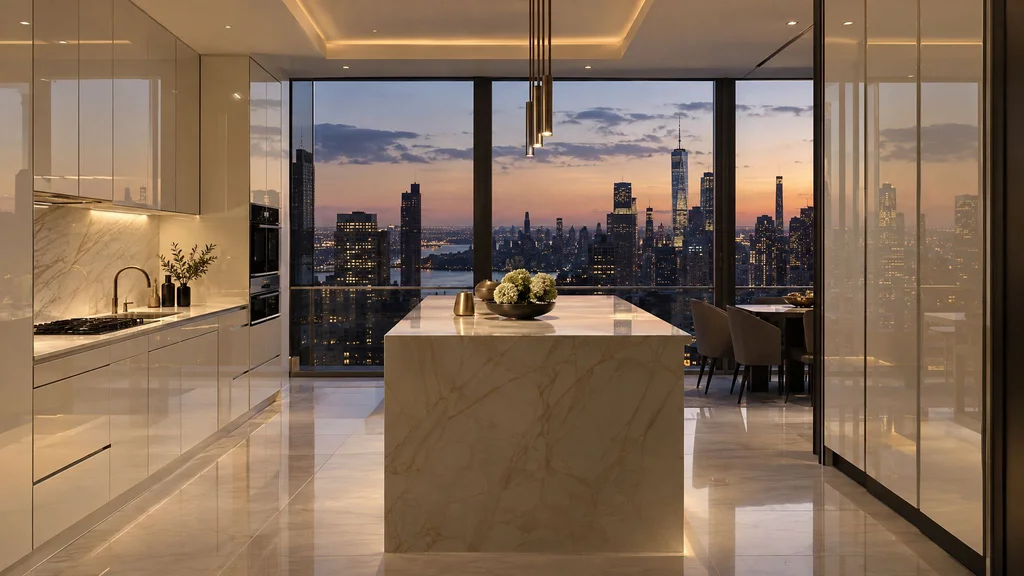
A high-gloss lacquer kitchen is unmistakable. The cabinet fronts reflect light like glass, colors look deep and saturated, and the whole room takes on a sleek, luxurious glow. It's a look associated with European design, luxury penthouses, and contemporary architecture. It's also the most demanding finish in cabinetry — beautiful when done well, and unforgiving of shortcuts. Here's what to know before you choose it.
What high-gloss lacquer is
Lacquer is a sprayed finish that builds in layers. A high-gloss lacquer finish is typically a pigmented (colored) lacquer applied in multiple coats over a perfectly prepared substrate, then either sprayed to a full gloss or wet-sanded and polished to a mirror finish. The result has depth — you seem to look into the color, not just at it. We cover lacquer finishes more broadly in our lacquer finish guide.
How it's made
A flawless substrate
Gloss magnifies every imperfection, so it starts with a stable, perfectly flat substrate — typically high-density MDF, which has no grain to telegraph through the finish. Edges must be perfectly shaped and sealed.
Primer and build coats
Multiple primer and color coats are applied, with sanding between each to create an absolutely level surface. Any dust, texture, or ripple left at this stage will be visible in the final finish.
Clear topcoats
Clear gloss topcoats add depth and protection.
Polishing
For the highest level of gloss, the cured finish is wet-sanded with progressively finer abrasives and buffed to a mirror-like surface — much like automotive paint. This is labor-intensive and requires full cure time between steps.
Every step happens in a controlled spray environment. See inside the spray booth for the fundamentals.
Why people love it
- Light: reflective surfaces bounce light around a room, making small or dim kitchens feel brighter and larger — a real advantage in many city apartments.
- Color depth: saturated colors look richer under gloss.
- Sleek minimalism: gloss pairs naturally with handleless, flat-panel design.
- Easy wiping: a smooth, sealed surface cleans easily.
The honest trade-offs
- Fingerprints and smudges show more readily, particularly on darker colors.
- Scratches are more visible on gloss than on matte finishes, though minor ones can often be polished out.
- Imperfections in the room — uneven walls, crooked lines — are reflected and amplified.
- Cost: the preparation and polishing make it one of the most expensive finishes.
- Repairs require professional touch-up to blend invisibly.
Choosing a color
Whites and ivories are the classic high-gloss choice: luminous, clean, and relatively forgiving of fingerprints. Deep colors — black, navy, burgundy, forest green — look dramatic and jewel-like but show smudges more readily. Mid-tones and warm neutrals like taupe and greige offer a balance. Always approve a physical sample in the room's actual light; gloss colors shift dramatically with light and reflections.
Handleless design
High gloss is often paired with handleless cabinetry: integrated finger channels (J-pulls or C-channels), push-to-open mechanisms, or recessed edge pulls. This keeps the reflective surfaces uninterrupted. If you prefer hardware, slim edge pulls in a coordinating metal finish work well. See choosing cabinet hardware finishes.
Balancing gloss with other materials
An all-gloss kitchen can feel cold. Many of the most successful designs pair high-gloss cabinetry with warmer, textured materials: a wood island, a honed stone counter, open shelves in walnut or oak, or a matte finish on tall walls with gloss on bases. See statement kitchen island ideas for ways to create contrast.
Maintenance
Clean with a soft microfiber cloth and mild soap and water; avoid abrasive pads, powders, and ammonia-based cleaners. Wipe spills promptly and dry the surface to prevent streaks. A microfiber cloth used dry removes most fingerprints. Minor surface scratches can sometimes be polished by a professional.
Gloss vs. satin vs. matte
If you love the idea of lacquer but worry about fingerprints and scratches, consider a satin sheen: smooth and refined, with a soft glow and far more forgiveness. Matte lacquer offers a velvety, contemporary look with minimal reflection. Our matte finish guide and cabinet finishes guide compare the options.
Where high gloss works best
- Modern and minimalist kitchens with flat-panel doors
- Apartments with limited natural light
- Bars, media walls, and furniture pieces as dramatic accents
- Bathrooms with sleek floating vanities
Cost factors
High-gloss lacquer costs more than satin or matte because of the additional coats, sanding, cure time, and polishing. Polished mirror finishes cost more than sprayed gloss. Color, door size, and the number of exposed edges all affect price. For context, see our custom kitchen cost guide.
Is it right for you?
How long a gloss finish lasts
A professionally applied, fully cured high-gloss lacquer is surprisingly durable in daily use. Most wear appears in predictable places — around handles or finger channels, near the trash pull-out, and on lower drawer fronts that get bumped by feet and chairs. With sensible care, a quality gloss finish looks excellent for many years, and localized wear can be professionally refreshed without refinishing the whole kitchen.
Gloss beyond the kitchen
Gloss lacquer is equally striking on a bar cabinet, a dressing room wardrobe, or a single piece of furniture. Used as an accent against matte walls and warm wood, it can be the jewel of a room. See designing a custom home bar for one example.
Lighting a gloss kitchen
Because gloss reflects light sources, lighting design matters more than usual. Pendants and downlights will appear as reflections in the cabinet faces, so their placement should be considered on the drawings. Linear LED strips under uppers can create beautiful, continuous highlights; poorly placed spotlights can create distracting hot spots. Warm, diffused lighting generally flatters gloss finishes most. We coordinate these details with your lighting designer or electrician before production.
If you love drama, light, and a crisp contemporary look — and you're comfortable with a little extra wiping — high-gloss lacquer is spectacular. If you want low maintenance above all, satin may be the smarter choice. We're happy to make samples in both so you can compare in your own space. Call (201) 281-1457 to discuss a custom kitchen finish.