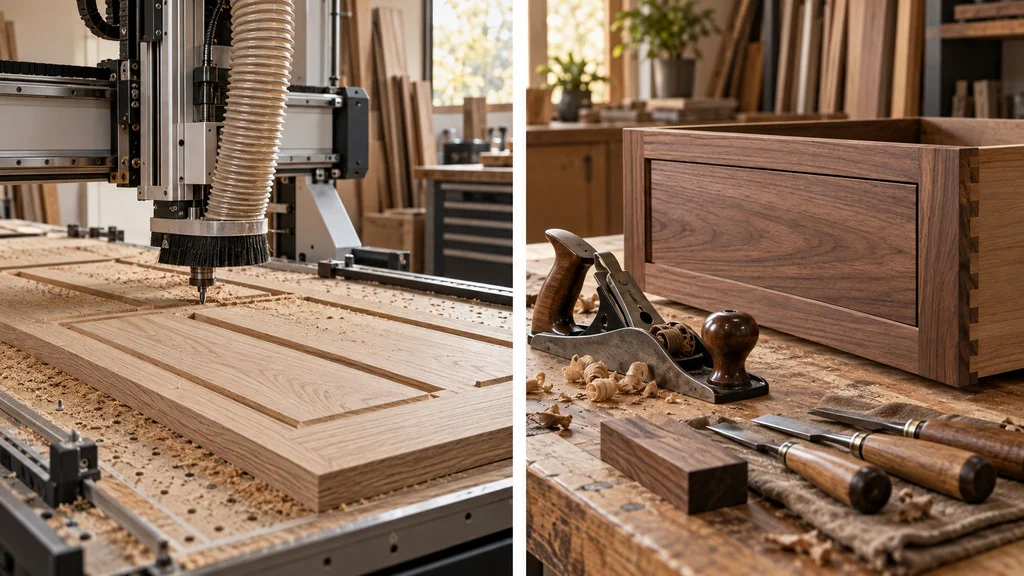
Clients sometimes ask, a little warily, whether our cabinetry is "handmade." It's a fair question, and the honest answer is more interesting than yes or no. Modern custom cabinetry is made by both machines and hands — and the best work comes from knowing exactly which to use for each step. A shop that insists on doing everything by hand isn't necessarily producing better cabinets, and a shop that runs everything through a machine isn't producing custom ones. Here's how the two actually work together.
What CNC machinery is
CNC stands for computer numerical control. In a cabinet shop, it usually means a router table that cuts panels to size, drills holes for hinges and shelf pins, and machines grooves and joinery according to a digital file generated from the shop drawings. Instead of a person measuring and marking each cut, the machine executes cuts to within a few thousandths of an inch — repeatably, part after part.
What machines do better
Precision and repeatability
A run of twelve doors needs twelve identical hinge bores, twelve identical sizes, and perfectly consistent reveals when installed. A CNC delivers that consistency every time. Hand-marking and hand-drilling the same parts introduces small variations that add up across a kitchen, showing up as uneven gaps and doors that don't quite line up.
Accurate joinery
Dados, rabbets, dowel holes, and many joinery cuts are more accurate when machined. Accurate joinery produces square boxes, and square boxes produce doors that hang true. We explain why that matters in cabinet construction explained.
Material efficiency
Nesting software lays out parts on sheets to minimize waste. That's good for cost and for the environment — a topic we cover in sustainable wood millwork.
Complex shapes
Curved parts, precisely radiused corners, fluted and reeded profiles, and intricate cutouts can be executed cleanly and consistently. Our guide to fluted and reeded millwork shows where these details shine.
What skilled hands do better
Material selection and grain matching
No machine decides which board becomes the drawer front above which door, or how the grain should flow across a run of cabinets. That's judgment — looking at color, figure, and grain direction and composing a result that looks intentional. It's the difference between cabinetry and furniture. See vertical vs. horizontal grain doors and veneer matching.
Fitting to a real room
Real rooms aren't square. Scribing a panel to follow a wavy plaster wall, fitting a filler to a floor that slopes, and adjusting a crown to a ceiling that dips — those are hand skills, performed with a pencil, a block plane, and experience. They're what make cabinetry look built-in rather than set in place.
Finishing
Sanding between coats, judging when a surface is truly smooth, adjusting a stain for how a particular board takes color — finishing remains largely a craft discipline. Read inside the spray booth for more.
Assembly, fitting, and adjustment
Dry-fitting assemblies, easing an edge so it feels right to the touch, hand-cutting a detail that only appears once, and adjusting every door and drawer until the reveals are perfect — all hand work.
Problem-solving
Every project brings a condition nobody anticipated. An experienced craftsperson can solve it on the bench or on site. A machine can only do what it's told.
The myth of "handmade is always better"
Historically, handmade meant quality because there was no alternative. Today, a hand-drilled hinge hole isn't better than a machined one — it's just less consistent. What matters is that the decisions are made by people who care, and that hand skills are applied where they add value. The best contemporary furniture and cabinet makers in the world use modern machinery.
The myth of "machine-made isn't custom"
Custom refers to design, not to the tool. A CNC-cut cabinet built to your exact dimensions, from your chosen species, finished to your sample, and scribed to your walls is completely custom. What makes cabinetry generic is standardized sizes and catalog choices — not the use of a machine. Our comparison of custom, semi-custom, and stock cabinets explains the real distinctions.
How we combine them in our shop
At our Little Falls shop, the workflow looks like this: shop drawings become digital files; the CNC cuts and machines parts with precision; craftspeople select and match materials, assemble boxes, build dovetailed drawers, and fit components; finishers sand and spray by hand in a controlled booth; and installers scribe and adjust everything on site. Each step uses the tool that produces the best result. You can follow the full sequence in how custom cabinets are made.
What this means for you
When evaluating shops, don't ask "is it handmade?" Ask better questions: Who selects and matches the wood? Who does the finishing, and where? Who installs, and how do they handle uneven walls? Are drawers dovetailed? What hardware is used? Those answers reveal craftsmanship far more reliably than a single word. Our lists of signs of quality and questions to ask a cabinetmaker help.
Where machines are headed
Technology keeps improving — better software, more capable machines, tighter integration between design and fabrication. That's good news for clients, because it makes complex designs more achievable and more affordable. But the core of fine cabinetry won't change: someone still has to look at a board and decide it's the right one, and someone still has to stand in your kitchen and make the last sixteenth of an inch disappear.
A note on the word "artisan"
Marketing loves words like artisan, bespoke, and handcrafted. They can mean a great deal or almost nothing. The only way to know is to visit a shop, see work in progress, and talk to the people doing it. That's why we invite clients into ours.
In short: machines give us accuracy; people give the work its soul. You want both in your kitchen.
If you'd like to see how precision machinery and craft come together on your kitchen, architectural millwork, or custom furniture project, call us at (201) 281-1457 to arrange a visit.