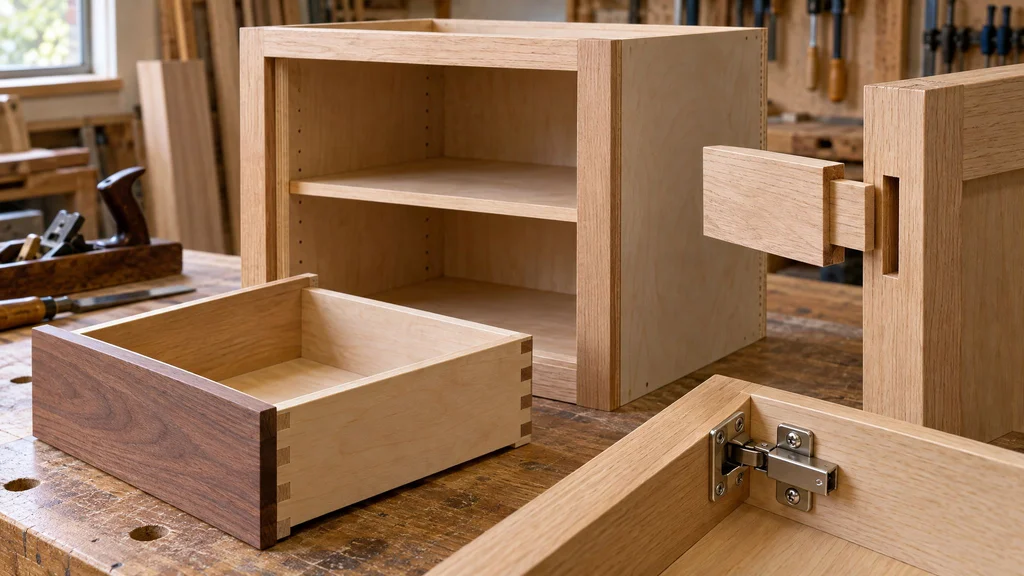
Two cabinets can share the same door style and finish and still be built completely differently underneath. Those differences — how the box is assembled, what it's made of, how the drawers are joined, how the doors mount — determine how the cabinet performs, how it looks up close, and how long it lasts. Here's a clear guide to the building blocks of cabinet construction, and what each choice means for you.
The two basic systems: frameless and face-frame
Frameless (European-style) construction
In frameless construction, the cabinet is a box with no front frame. Doors mount directly to the box sides with concealed hinges and cover nearly the entire front. The result is a clean, contemporary look with tight, consistent reveals, and slightly more interior access because there's no frame narrowing the opening. Frameless construction relies on precision machining, which is why it's the natural system for CNC-built cabinetry. It's the foundation of most modern and minimalist kitchens.
Face-frame construction
Face-frame cabinets have a solid wood frame attached to the front of the box. Doors either overlay the frame or sit inside it (inset). The frame adds rigidity and a more traditional, furniture-like character. Face-frame construction is common in classic American kitchens and is essential for true inset doors.
Neither is inherently better — they're different aesthetics with different strengths. Your door style usually determines which system makes sense.
Door overlay styles
Full overlay doors cover almost the entire cabinet front, leaving small reveals between doors. It's the typical choice for frameless kitchens and clean, modern looks.
Partial overlay doors leave more of the face frame visible. Common in builder-grade cabinetry; less common in high-end custom work.
Inset doors sit flush inside the face frame, with even gaps all around. Inset is the most demanding to build and install — the reveals must be perfect and stay perfect as the wood moves — and it's one of the clearest signatures of custom craftsmanship. We compare costs in inset vs. overlay cabinets.
Case materials
The box itself — sides, bottom, top, back — is usually built from sheet goods. Cabinet-grade plywood is strong, holds screws well, and resists moisture. Particleboard and MDF cores are denser and very flat but weaker with fasteners and more vulnerable to water. High-quality custom work typically uses plywood or premium veneered panels for cases, particularly in sink bases and wet areas. Case sides are usually ¾ inch thick in quality work.
Backs matter more than people realize: a thick back that's captured in a groove adds rigidity and gives upper cabinets something solid to fasten through into the wall. A thin back stapled on does neither.
Joinery: how the box holds together
Cases can be assembled with dowels, confirmat screws, dados and rabbets (grooves that interlock panels), or combinations of these, and are glued and clamped square. Face frames are traditionally joined with mortise-and-tenon joints or pocket screws, then glued and fastened to the case. The goal is a box that stays square under load for decades. We walk through how this happens in the shop in how custom cabinets are made.
Drawer construction
Drawers work harder than any other part of a kitchen. The strongest drawer boxes use dovetail joints at the corners — interlocking fingers that resist being pulled apart — with solid hardwood or quality plywood sides and a bottom captured in a groove. Budget cabinetry often uses stapled or doweled corners with thin bottoms that sag under weight. The difference becomes obvious in a few years.
Hardware: slides and hinges
Full-extension, soft-close undermount slides carry heavy loads smoothly and let you reach the back of the drawer. Concealed European hinges with three-way adjustment allow doors to be realigned as the house settles. Hardware quality is one of the easiest things to evaluate — and one of the most important. For decorative pulls and knobs, see choosing cabinet hardware finishes.
Door construction
Doors can be slab (a single flat panel, often veneered), five-piece (a frame of stiles and rails around a center panel, as in a Shaker door), or more elaborate profiles. Solid-wood center panels "float" in their frames so they can expand and contract without cracking — a detail explained in wood movement and custom cabinetry. Veneered slab doors use stable cores so they stay flat. For painted doors, construction choices aim to minimize visible movement at joints.
Toe kicks, bases, and leveling
Cabinets sit on either integrated toe kicks or separate leveling bases. Separate bases make it easier to level cabinets precisely on uneven floors — common in older homes — and allow the toe kick to be finished or recessed as a design detail, such as a shadow line that makes cabinetry appear to float.
Interiors and edge details
Interior finishes, banded shelf edges, adjustable shelf systems, and thoughtfully sized drawers are all part of construction quality. So are exposed edges: quality work bands or finishes every visible edge so there's no raw core showing.
How to use this when evaluating cabinetry
When you look at any cabinet, open it up. Look at the case material and back, pull out a drawer and check the corners, feel the slides, and look at the hinges. These construction details are far better indicators of quality than the door style on display. Our checklist of signs of quality custom cabinetry puts it all together, and our comparison of custom, semi-custom, and stock cabinets shows how construction changes across tiers.
Construction in bathrooms and other wet areas
Vanities and laundry cabinetry face more humidity than kitchen cabinets, so construction choices matter even more. Moisture-resistant substrates, fully sealed edges and interiors, and finishes rated for wet environments all extend the life of bathroom cabinetry considerably. Our guide to the best wood for a bathroom vanity covers species and finish choices for humid rooms.
We build both frameless and face-frame cabinetry, including true inset work, for kitchens, vanities, and closets across the tri-state area. If you'd like to see construction samples in person, visit our Little Falls shop or call (201) 281-1457.