Kitchen cabinetry comes in three broad tiers: stock, semi-custom, and custom. In a showroom or on Instagram, they can look remarkably similar. Live with them for a few years, though, and the differences show up in the gaps, the drawers, the finish, and how well the kitchen actually fits the room. Here's a clear-eyed comparison of what changes at each level.
Stock cabinets
Stock cabinets are mass-produced in fixed sizes — typically in three-inch width increments — and sold ready to ship or with short lead times. You choose from a limited catalog of door styles and finishes, and the boxes are usually built from particleboard or MDF with thin backs.
Where they make sense: rental units, laundry rooms, garages, and tight budgets where speed matters more than fit.
The trade-offs: because sizes are fixed, your kitchen is designed around the boxes rather than the room. The leftover space gets filled with filler strips, and tall or unusual walls rarely get used efficiently. Construction is the most basic of the three tiers.
Semi-custom cabinets
Semi-custom cabinets start with standard box sizes from a manufacturer but allow modifications: adjusted depths, taller uppers, a wider selection of door styles, finishes, and interior accessories. Most large cabinet brands sold through kitchen dealers fall in this category.
Where they make sense: standard-layout kitchens where you want more choice than stock without a fully bespoke price.
The trade-offs: you still work within a manufacturer's system. Modifications have limits and upcharges, sizes still come in increments, and finish options are the brand's options — not a color matched to your designer's sample. Quality varies widely by brand.
Custom cabinets
Custom cabinets are built from scratch to your exact dimensions, by a shop that controls construction, materials, and finish. Every box is sized to the room. Any species, veneer, or finish can be specified. Details like inset doors, integrated appliances, curved ends, and furniture-style pieces are designed in rather than added on.
Where they make sense: kitchens where fit and detail matter, older or irregular rooms, specific design visions, and anyone who plans to stay in the home long enough to care how it ages.
The trade-offs: longer lead times and a higher investment. You're paying for design time, skilled labor, and materials chosen for performance rather than cost. We describe what goes into it in how custom cabinets are made.
The differences that actually matter
Fit
This is the biggest one. Custom cabinetry is sized to the millimeter and scribed to your walls; stock and semi-custom are sized to a catalog. In a pre-war New York apartment with wandering walls, or a New Jersey home with an odd corner, the difference is visible every day.
Construction
Box material, back thickness, drawer construction, and hardware improve as you move up the tiers — though the best semi-custom brands can overlap with entry-level custom. Look at drawer joinery, slides, and hinges. Our list of signs of quality custom cabinetry is a good checklist for any tier.
Door styles and details
True inset doors, where the door sits flush inside the frame, are demanding to build well and are one of the clearest markers of custom work. We compare the approaches, and their costs, in inset vs. overlay cabinets.
Materials and finishes
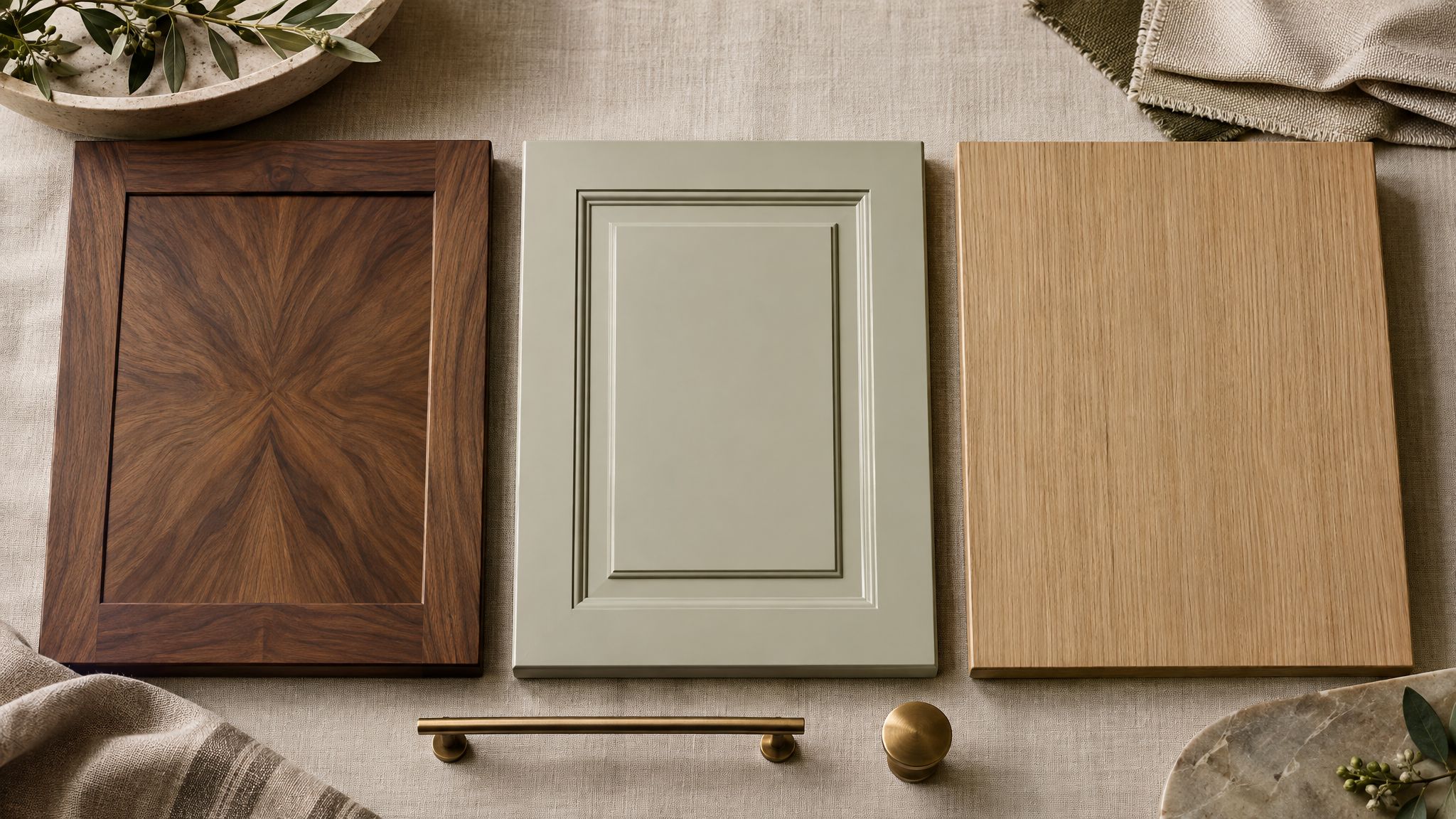
Custom opens up everything: rift-sawn white oak, book-matched walnut, specific veneers, hand-applied oil finishes, a paint color matched to a fabric swatch. Semi-custom offers a curated menu; stock offers a short list. If finish matters to you, read our cabinet finishes guide and our comparison of painted, veneer, and thermofoil doors.
Storage efficiency
Because custom cabinetry uses every inch, it often delivers meaningfully more usable storage in the same footprint — full-height pantries, drawers sized to your cookware, appliance garages, and corners that work.
Lead time
Stock can ship in days, semi-custom typically takes several weeks, and custom usually takes a few months including design and drawings. We lay out realistic ranges in how long custom millwork takes.
What about cost?
Stock is the least expensive, custom the most, with semi-custom in between — but the ranges overlap more than people expect. A heavily modified premium semi-custom kitchen can approach the cost of a custom one, without the fit and flexibility. And in high-end renovations, the cabinetry is often a smaller share of the total project cost than the stone, appliances, and construction, which makes the upgrade to custom proportionally smaller than it looks. For NYC-specific numbers, see our custom kitchen cabinet cost guide.
How to decide
Ask three questions. Does the room have irregularities that standard sizes will fight? Do you have a specific design vision that a catalog can't deliver? And how long will you live with this kitchen? If the answer to any of those points toward fit, detail, and longevity, custom is usually worth it. If speed and budget dominate, a good semi-custom line can be the right call.
Common myths worth clearing up
"Custom always takes a year." Not true — most custom kitchens are delivered in a few months once design decisions are made. Delays usually come from decisions, not fabrication.
"Semi-custom is basically custom." Sometimes close, often not. The test is whether the kitchen is designed around your room or around a catalog's box sizes.
"Custom is only for huge kitchens." In fact, small and awkward spaces benefit most, because every inch counts and standard sizes waste the most room there. Some of our favorite projects are compact Manhattan galley kitchens.
Can you mix tiers?
Yes, and it's often smart. Some clients put custom cabinetry in the kitchen and main living spaces, where fit and detail are most visible, and use a good semi-custom line in a basement or utility room. The key is being deliberate about where craftsmanship pays off most for you.
We build fully custom kitchens in our Little Falls shop for clients across New Jersey, New York City, Westchester, and Fairfield County. If you're weighing the options, we're happy to walk through what custom would mean for your specific room — call (201) 281-1457.