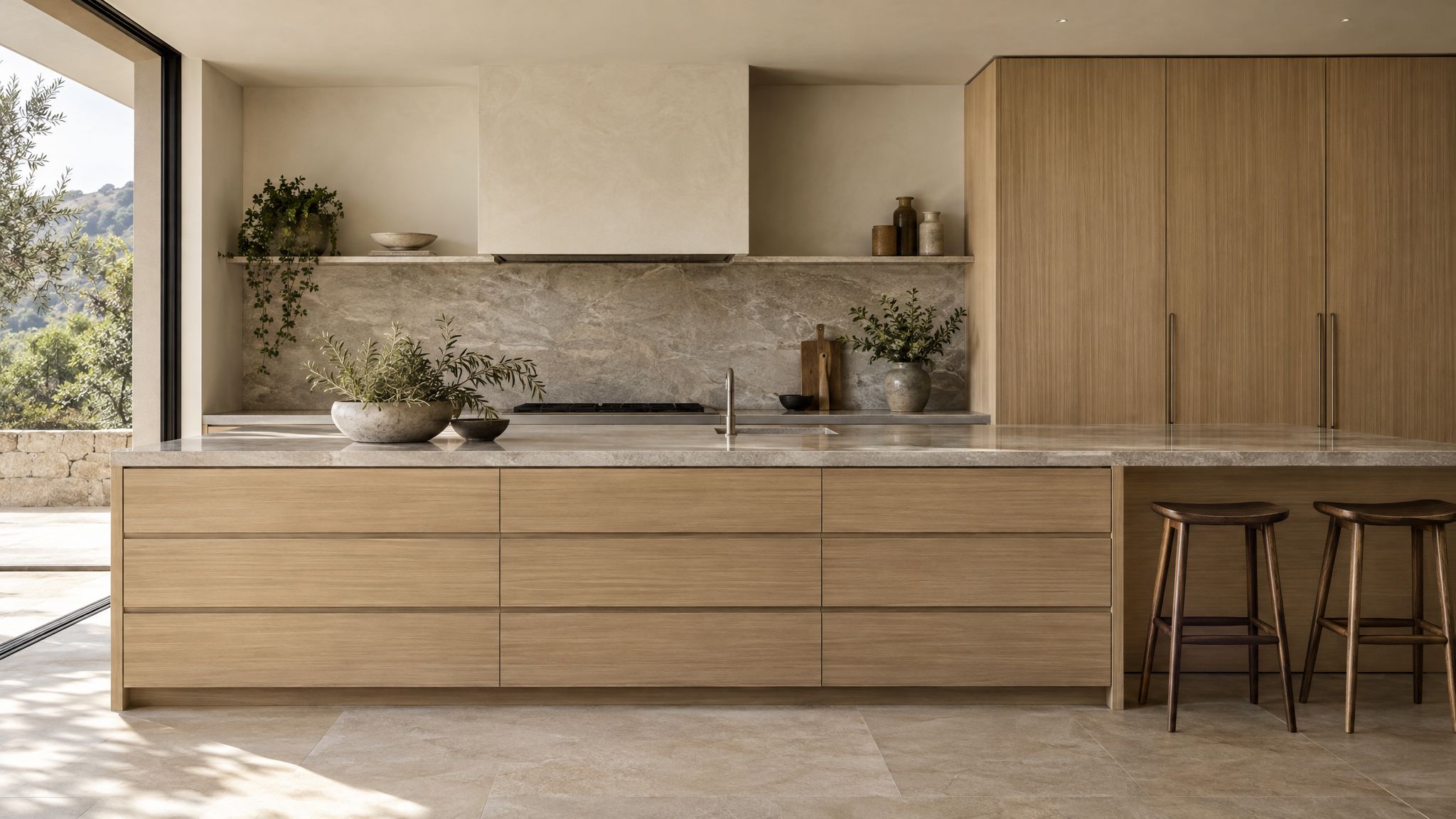
When clients choose a wood kitchen, they think about species and color first. Grain direction usually comes up later, if at all — yet it has a surprising effect on how a room feels. The same rift white oak cabinetry can read as tall and architectural or long and serene depending entirely on which way the grain runs. Here's how to think about vertical versus horizontal grain, and how to use both deliberately.
Vertical grain: height and tradition
Vertical grain is the conventional choice, and for good reason. Solid wood doors are traditionally built with grain running vertically in the stiles (the side pieces), and most people expect cabinetry to look this way. Vertical grain draws the eye upward, emphasizing height — useful in rooms with tall ceilings, full-height pantry walls, and narrow spaces where you want a sense of lift. It tends to feel classic and familiar.
Horizontal grain: calm and contemporary
Horizontal grain runs side to side, leading the eye across the room. It creates a sense of width and repose, and it's strongly associated with modern, minimalist, and mid-century design. In a kitchen with long runs of base cabinets, horizontal grain flowing across a series of drawers produces a continuous band of wood that feels architectural rather than assembled from separate boxes.
Continuous grain: the signature of refined work
The most striking effect isn't just grain direction — it's grain continuity. When drawer fronts and doors are cut sequentially from the same panel, the grain flows uninterrupted from one to the next, as if the whole run were a single slab. This takes planning: parts must be laid out and cut in order, and kept in sequence through finishing and installation. It's one of the clearest markers of high-end custom cabinetry, and it's usually done with sequenced veneer. See veneer matching explained.
Why veneer makes horizontal grain practical
Solid wood expands and contracts across its grain with changes in humidity, not along it. A wide solid-wood drawer front with horizontal grain would change height seasonally, which can cause binding or uneven reveals. Veneer on a stable core doesn't move meaningfully in either direction, so it's the natural choice for horizontal grain and for continuous-grain runs. We explain wood movement in wood movement and custom cabinetry, and compare materials in veneer vs. solid wood.
Mixing directions deliberately
Some of the most sophisticated kitchens use both. A common approach: horizontal grain across base drawers and islands to create calm horizontal bands, with vertical grain on tall pantry and appliance walls to emphasize height. Another: vertical grain on the perimeter, with a horizontal-grain island as a contrasting centerpiece. What matters is intention — the mix should look designed, not accidental.
How species affects the decision
Straight-grained woods like rift-sawn white oak look excellent in either direction and are especially effective horizontally, where their linear grain produces clean stripes. Figured woods like walnut, with more movement in the grain, can create dramatic effects horizontally but may look busy if not carefully matched. Our walnut vs. white oak comparison discusses each species' character, and quartersawn vs. riftsawn vs. plainsawn explains how the cut affects grain pattern.
Grain direction in different rooms
Kitchens
Horizontal grain on long base runs and islands is popular in contemporary kitchens; vertical is typical in traditional and transitional designs.
Bathrooms
Floating vanities with horizontal grain emphasize their width and create a sleek, hotel-like look. See floating vs. floor-standing vanities.
Closets and wardrobes
Tall wardrobe doors usually look best with vertical grain, which reinforces their height.
Media walls and paneling
Horizontal grain across a media wall can create a calm backdrop for a television; vertical panels suit libraries and tall rooms. See designing a custom media wall.
Practical considerations
- Cost: continuous and sequence-matched grain requires more material and layout time, so it costs more than randomly selected doors.
- Replacement: if a door is damaged years later, matching continuous grain exactly is difficult; we recommend keeping any spare panel material.
- Hardware: continuous grain looks best with minimal hardware — finger pulls, push-to-open, or edge pulls — so nothing interrupts the flow.
- Reveals: tight, consistent reveals make continuous grain read as a single surface.
How to decide
Start with the room's proportions and the feeling you want. If the space feels low or you want to emphasize height, lean vertical. If you want calm, width, and a contemporary architectural look, consider horizontal — ideally with continuous grain. If the kitchen has both long runs and tall elements, a deliberate combination may be best. Ask to see large samples or completed work; grain direction is much easier to judge at full scale than on a small chip.
Our approach
Grain direction and hardware placement
Grain and hardware should work together. With horizontal grain, long edge pulls or integrated channels running the width of drawers reinforce the horizontal lines. With vertical grain, vertical bar pulls on doors emphasize height. Placing hardware against the grain's direction can work as a deliberate contrast, but it should be a choice rather than a default.
Common mistakes
The most common misstep is mixing grain directions randomly — horizontal on one drawer, vertical on the next — without a clear logic. Another is using horizontal grain on solid-wood drawer fronts that are too wide, which invites seasonal movement problems. And a subtle one: failing to align grain between a drawer and the door below it, so the eye catches a break where it expected continuity. All three are avoided by planning grain on the drawings.
If you're unsure, ask for two large mock-up panels in each direction and prop them against the wall where the cabinetry will go. Five minutes of looking usually makes the decision obvious.
We plan grain direction and sequence on the shop drawings and lay out parts before cutting, so the finished kitchen reads exactly as designed. It's a small detail with a big effect — the kind of decision that separates cabinetry from craft. If you're considering a wood custom kitchen or vanity, call us at (201) 281-1457 to see samples.