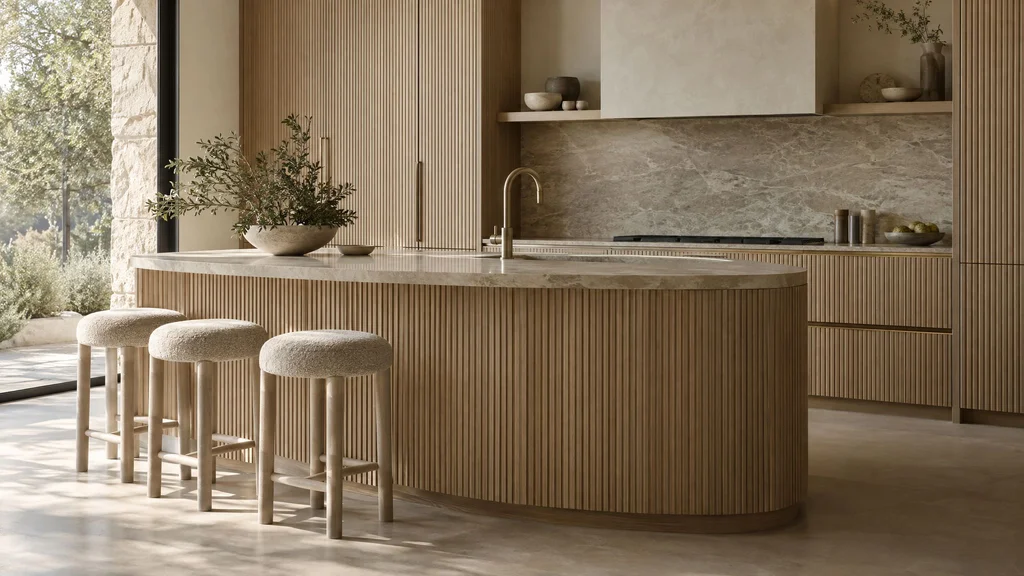
Fluting and reeding — vertical grooves or rounded ribs cut into a surface — have become one of the defining details in contemporary interiors. You see them on kitchen islands, bathroom vanities, bar fronts, headboards, and entire walls. Used well, they add texture, rhythm, and a sense of craftsmanship that flat panels can't. Used carelessly, they can feel like a passing trend. Here's how to use them in a way that will still look right in fifteen years.
Fluting vs. reeding: what's the difference?
Fluting is a series of concave grooves cut into a surface — think of the channels on a classical column. It creates shadow lines and a crisp, architectural rhythm.
Reeding is the inverse: a series of convex, rounded ribs that project from the surface, like a bundle of reeds. It feels softer and more tactile.
Both have classical roots — they appear in ancient Greek architecture, Regency furniture, and Art Deco interiors — which is part of why they feel timeless when proportioned well.
Where fluting and reeding work best
Kitchen islands
A fluted or reeded island front is one of the most effective uses of the detail. The island is a freestanding object meant to be looked at, and texture turns it into a sculptural centerpiece — especially on a curved island, where the grooves follow the radius. See statement kitchen island ideas.
Bathroom vanities
Fluted vanity fronts add depth to a small room without clutter, and pair beautifully with stone tops and brass fittings. See custom bathroom vanity design.
Bars and furniture pieces
Bar fronts, sideboards, credenzas, and nightstands are natural candidates. The detail reads as furniture craftsmanship. See designing a custom home bar.
Accent walls and reception desks
A fluted wall panel behind a bed, in a dining room, or at a commercial reception desk creates a dramatic backdrop that plays with light throughout the day. See custom reception desks.
Where to be careful
Fluting everything is the fastest way to make it feel like a trend. As a rule, use it as an accent: one element in a room, not every surface. Full kitchens of fluted doors can feel busy and are harder to keep clean, since grooves collect dust and grease. Fluting on frequently touched surfaces near cooking areas requires a durable finish and occasional detailed cleaning.
Proportion is everything
The spacing and depth of the flutes determine whether the detail feels refined or heavy. Narrow, shallow flutes feel delicate and contemporary; wider, deeper flutes feel bolder and more traditional. The flute width should relate to the size of the piece — a small nightstand wants finer fluting than a ten-foot island. Flutes should also resolve cleanly at edges and corners, which requires planning the layout so a full flute (not a partial one) lands at each end. We work these details out on the shop drawings and often make a sample section before production.
How fluted millwork is made
Fluting and reeding can be machined into solid wood, into thick veneered panels, or created from individual strips assembled into a panel. Modern CNC machinery makes consistent spacing and depth achievable across long runs and curves; hand finishing then softens edges and prepares the surface. We explain that collaboration in CNC vs. handmade cabinetry. On curved pieces, flutes may be machined into bent laminations or coopered segments that follow the radius.
Materials and finishes
Fluting works in both stain-grade and paint-grade materials. In wood, straight-grained species like rift white oak and walnut emphasize the vertical rhythm. Painted fluting — in a soft neutral or a deep color — reads more architectural and emphasizes shadow. Matte finishes let the texture speak; gloss finishes create striking highlights on each rib. See our matte finish guide.
Pairing with other elements
Fluting looks best with a calm context: a simple stone top, restrained hardware (or none), and flat surrounding surfaces. Integrated finger pulls or push-to-open doors keep hardware from interrupting the rhythm. Warm brass and bronze fittings complement fluted wood especially well; see choosing cabinet hardware finishes.
Lighting fluted surfaces
Light is what makes fluting come alive. Side light — from a window or a wall grazer — casts shadows in each groove and dramatizes the texture. Flat, frontal light can make fluting almost disappear. When planning a fluted wall or island, consider how light will fall on it at different times of day.
Cleaning and maintenance
Grooves collect dust. A soft brush attachment on a vacuum or a soft paintbrush makes cleaning easy. In kitchens, a durable finish lets you wipe grease with mild soap. Avoid abrasive pads that can burnish the edges of the ribs.
Cost considerations
Fluting and reeding add machining, finishing, and layout time, so they cost more than flat panels. Curved fluted work costs more still. Using fluting as a focused accent — on an island or a single wall — delivers most of the visual impact at a fraction of the cost of fluting an entire room. For budget context, see our architectural millwork cost guide.
Is fluting a trend?
Fluting in commercial spaces
In restaurants, hotels, and offices, fluted millwork does double duty: it adds warmth and texture, and it hides the minor scuffs that flat surfaces show under heavy use. Reception desks, bar fronts, and host stands are especially good candidates. For commercial work, we specify durable finishes and sometimes protective edges at kick height. See restaurant millwork for more.
A sample section is the best way to judge flute spacing and depth before committing — we make one for every fluted project.
Its current popularity is a trend; the detail itself is thousands of years old. The versions that last are the ones that are well proportioned, used with restraint, and executed with precision. That's the approach we take in our kitchens, vanities, and custom furniture. If you're considering a fluted piece, call us at (201) 281-1457 — we'll make a sample so you can see it in your own light.