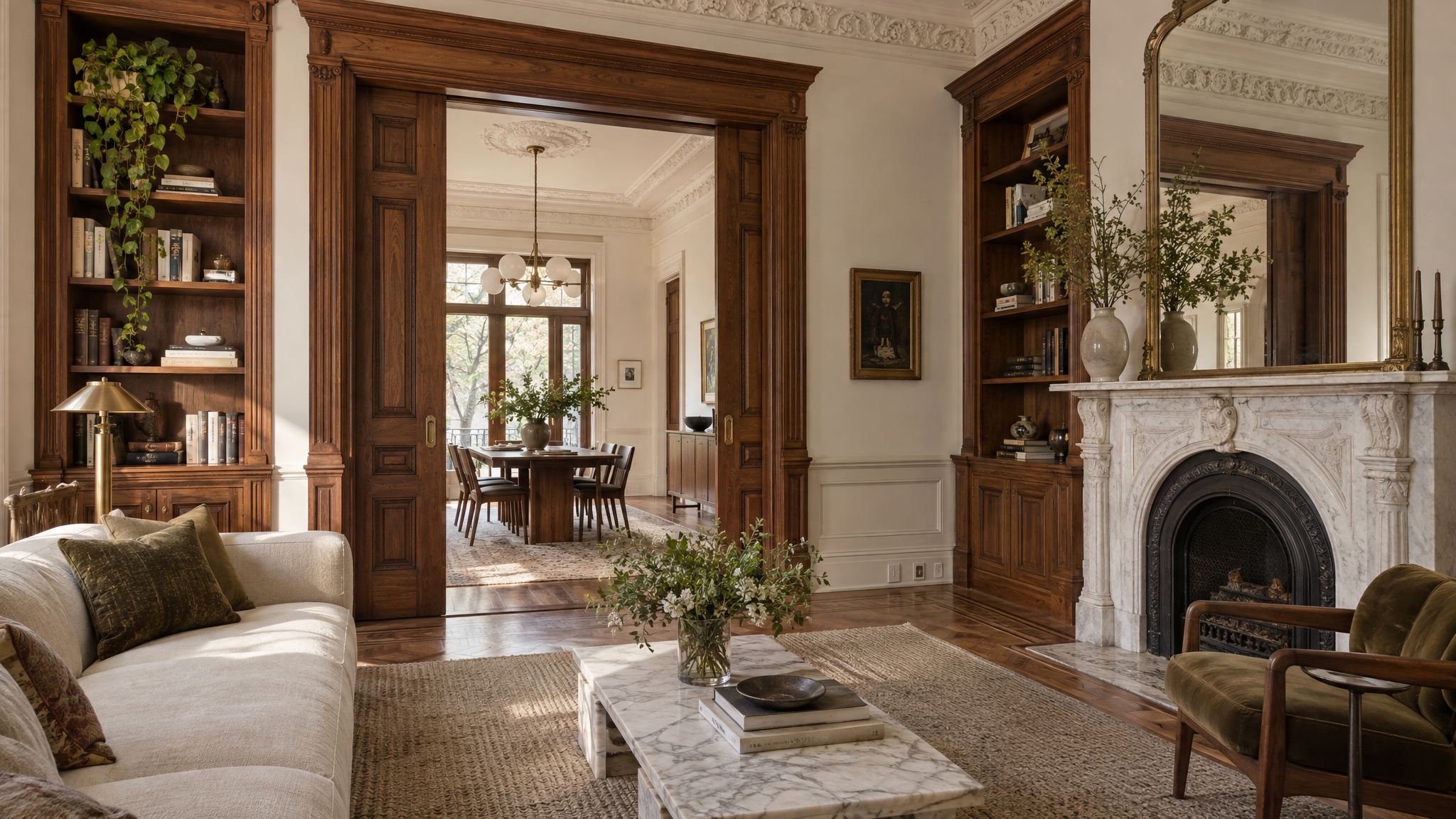
Brooklyn's brownstones and rowhouses, from Brooklyn Heights and Cobble Hill to Park Slope, Fort Greene and Bedford-Stuyvesant, were built during a period when woodwork was a primary means of expressing status and craft. Parlor floors had pocket doors, carved casings, paneled wainscoting, elaborate newel posts and built-in pier mirrors. A century and a half later, some houses retain nearly all of it, some retain fragments, and some were stripped in mid-century renovations. Whatever state your house is in, millwork is central to bringing it back to life. This guide covers restoration, reproduction and new work in a brownstone context.
Start with what you have
Before designing anything new, document the woodwork that survives. Walk each floor and photograph casings, baseboards, door panels, stair parts, mantels and shutters. Note the wood species, since many parlor floors used walnut, mahogany, or oak with a grained finish, while upper floors were often pine intended to be painted. Look for paint layers on originally stained wood, missing pieces, water damage near windows and the rear wall, and later alterations.
This inventory drives the rest of the project. Surviving elements set the profiles, proportions and finishes for any new work, so the house reads as a whole rather than a collection of eras.
Restoring original millwork
Restoration is usually more valuable, and more authentic, than replacement. Common work includes:
- Pocket doors: rehabilitating tracks and hangers, repairing split stiles, and refinishing so the doors glide again.
- Casings and baseboards: stripping paint from originally stained wood where appropriate, consolidating damaged sections and patching with matching species.
- Interior shutters: repairing louvers and panels and re-hanging them in their pockets.
- Stair parts: tightening balusters, repairing handrails and newels, and matching missing turned pieces. See staircase millwork details and custom staircase millwork.
- Mantels: marble mantels are usually a stone restorer's job, but wood mantels and overmantels are firmly millwork. See fireplace surrounds and mantels.
Reproducing what's missing
When original woodwork has been lost, we reproduce it. The process starts with a surviving sample, a profile taken from a neighboring house of the same builder, or historical references. We create custom profile knives to run moldings that match the originals exactly, then build casings, baseboards, crowns, and panels in the appropriate species. In a parlor with one surviving door casing and three missing ones, reproduction makes the room whole again.
Matching the finish is as important as matching the profile. Old stained woodwork has a depth and patina that new wood lacks. A custom stain match, built up in layers and sampled against the original, makes reproductions blend. Our interior door casing guide and crown molding guide cover profile basics.
Designing new millwork for a historic house
Most brownstone renovations also need new millwork that the original builders never imagined: a modern kitchen, closets, media storage, a home office. The approach depends on the house and the owner's taste, but a few principles help.
Kitchens
Brownstone kitchens were typically on the garden level. Many owners now move the kitchen to the parlor floor's rear room for light and connection to the garden. A parlor-floor kitchen sits among the house's grandest rooms, so its cabinetry should hold its own: tall cabinetry that respects the ceiling height, inset doors, a stone counter and a scaled crown. Others choose a deliberately modern kitchen, often walnut or rift oak with clean slabs, as a counterpoint to restored period rooms. Both work when proportions respect the room. See our Park Slope kitchen post for inspiration.
Built-ins
Brownstones have alcoves beside chimney breasts that are perfect for built-in bookcases, and parlor rooms deep enough for a library wall. Built-ins that borrow the house's casing and baseboard profiles look original.
Closets
Nineteenth-century rowhouses had few closets. Adding them without damaging proportions takes care. Freestanding-looking wardrobes, closets tucked into the space between front and rear bedrooms, and built-ins under stairs all help. Our reach-in closet organizer post covers smaller spaces.
Landmarks considerations
Many Brooklyn brownstone neighborhoods are designated historic districts under the Landmarks Preservation Commission. Landmarks jurisdiction focuses primarily on exteriors, including facades, stoops, windows, doors and visible rooftop additions, rather than interior woodwork. Still, exterior doors, vestibule elements and window work may require LPC approval, and your architect should confirm what applies before work begins.
Dealing with old walls and floors
A brownstone may have settled by an inch or more across its width. Floors slope toward the center, walls lean, and nothing is square. New millwork must be scribed carefully, and tall cabinetry must be leveled independently of the floor. Our installation process post explains how we handle it, and wood movement matters too, since brownstones with original windows swing widely in humidity.
Budget priorities
Brownstone millwork budgets stretch fastest when owners try to do everything at once. A sensible order: first restore and reproduce the parlor floor woodwork, since it defines the house; second build the kitchen; third add storage and built-ins upstairs. For typical ranges, see architectural millwork cost in NYC and millwork cost per linear foot.
Frequently asked questions
Should I strip painted woodwork? Only if it was originally stained and the wood beneath is worth revealing. Parlor-floor hardwoods often are; upper-floor pine usually was meant to be painted.
Can you match a molding from a single fragment? Usually, yes. A few inches of intact profile is enough to make matching knives.
Is it better to restore or replace pocket doors? Restore where possible. Original doors are old-growth wood that is difficult to replicate, and the hardware can usually be rebuilt.
A room-by-room restoration checklist
- Vestibule and entry hall: inner doors, wainscoting, newel post and the first flight of the stair set the tone for the whole house, so they deserve first priority.
- Parlor floor: pocket doors, window casings, shutters, pier mirror frames and baseboards. This is where original hardwoods and the finest carving usually survive.
- Garden level: often heavily altered; a good place for a new kitchen, family room built-ins or a mudroom that borrows period profiles.
- Upper floors: simpler painted pine trim that is easy to reproduce, plus closets and bedroom built-ins added with care.
Working in this order keeps the most important rooms consistent and lets later phases draw their profiles and finishes from work already completed.
We serve Brooklyn Heights, Cobble Hill, Park Slope and Williamsburg. Learn more about our architectural millwork, or read what architectural millwork is.