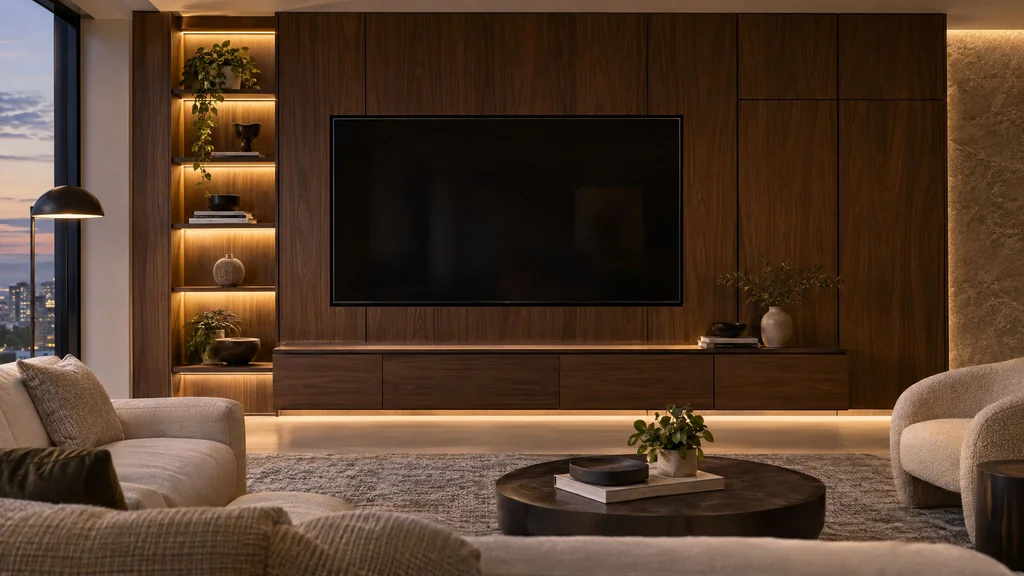
The television is the one object in most living rooms that nobody wants to look at when it's off — yet it often dictates the entire layout. A custom media wall solves that tension. It integrates the TV, speakers, equipment, and storage into a single composed piece of millwork that looks intentional whether the screen is on or not. Here's how to design one that works as well as it looks.
Start with the screen
Size
Choose the screen size based on viewing distance and room scale. Too large and it overwhelms; too small and the millwork dwarfs it. Decide on the TV model before the millwork is designed, since the opening is built around its exact dimensions — and allow room for future upgrades.
Height
Mount the screen so the center is roughly at seated eye level. A common mistake is mounting too high, especially above a fireplace. See fireplace surrounds for that trade-off.
Framing vs. concealing the TV
Framed
The TV sits in a recessed niche or against paneling, framed by surrounding millwork. Dark paneling around the screen makes it recede when off.
Concealed
Pocket doors, bifold doors, or sliding panels hide the TV entirely, revealing it only when in use. This is ideal for formal living rooms or anyone who wants the room to feel screen-free.
Art-style displays
Some TVs display artwork when off; framing them in millwork completes the illusion.
Cable management and power
Nothing ruins a media wall like visible wires. Plan power outlets behind the TV, conduit for HDMI and future cables, and a pathway to the equipment cabinet. Coordinate with your electrician and AV installer before walls are closed. Leave access so cables can be changed later.
Equipment storage and ventilation
Receivers, streaming boxes, game consoles, and networking equipment need a home — usually a low credenza or cabinet. Electronics generate heat, so cabinets need ventilation: perforated backs, slotted panels, or active fans. Doors should allow remote signals through, via IR-transparent panels, mesh or grille doors, or IR repeaters.
Speakers
Speakers can be integrated behind acoustically transparent fabric panels, recessed into the wall or ceiling, or placed on shelves within the built-in. A soundbar can sit in a dedicated recess below the screen. Coordinate with your AV specialist on placement for the best sound.
Storage and display
Beyond equipment, media walls often include closed storage for games and remotes, open shelves for books and objects, and display niches with lighting. Balance open and closed storage so the wall doesn't look cluttered.
Lighting
Integrated LED lighting — backlit shelves, a soft glow behind the TV (bias lighting reduces eye strain), and accent lighting on display niches — adds depth and atmosphere. Dimmers let the wall shift from daytime display to movie-night mode.
Floating designs
Wall-hung credenzas and floating cabinets create a light, contemporary look and make floors easier to clean. They must be securely anchored to framing. See floating vs. floor-standing principles, which apply here too.
Materials and finishes
Walnut and dark stains help a black screen blend in. Rift white oak creates a lighter, Scandinavian feel. Painted millwork suits traditional rooms. Horizontal grain across a long media wall creates calm lines; see vertical vs. horizontal grain. Fluted panels add texture; see fluted millwork.
Media walls in apartments
In New York apartments, a media wall can also define space in an open-plan living area, hide radiators or columns, and add storage where closets are scarce. Shallow designs preserve floor area. Building rules may restrict wall penetrations, which affects wiring strategy.
Media rooms and home theaters
For dedicated media rooms, millwork can include acoustic paneling, tiered seating platforms, concealed projectors and screens, and dark finishes that minimize reflections. These projects involve close coordination with AV and acoustic specialists.
Cost factors
Cost depends on wall size, materials and finish, concealment mechanisms like pocket doors, integrated lighting, ventilation, speaker integration, and complexity. A simple floating credenza with a paneled backdrop is modest; a full-wall composition with concealed TV, lighting, and integrated sound is more significant. See our built-in wall cost guide for related pricing.
Designing for the screen you'll have next
TVs get bigger and thinner every few years. We design openings and mounting to accommodate future screens where possible, so the millwork outlasts the electronics.
Frequently asked questions
Should I buy the TV before designing the wall? Ideally, yes — or at least decide on the size and model, since the opening and mounting are built around it.
Can equipment be hidden in another room? Yes. Many AV installers locate equipment in a closet or cabinet elsewhere, leaving the media wall clean and cool.
How deep should a media wall be? Credenzas are commonly 16 to 20 inches deep; the wall behind the TV can be much shallower, especially with a flush mount.
Will doors block the remote? Not if they're designed with IR-transparent panels, grilles, or with an IR repeater system.
Can a media wall include a fireplace? Yes, especially with a linear gas or electric unit — though heat and viewing height need careful planning.
Designing it as architecture
The best media walls don't read as furniture for a television. They read as architecture: a composed wall with proportion, material, and light, in which the screen is just one element. That's the standard we design to.
Planning checklist
- Choose the TV size and model, and note its dimensions and mounting pattern.
- Decide where equipment lives and how cables will travel.
- Plan speakers with your AV installer before drawings are final.
- Decide whether the TV is framed, concealed, or displayed as art.
- Plan dimmable lighting for shelves and backlighting.
Get these decisions made early and the millwork can hide every wire, vent every component, and frame the screen perfectly — so the wall looks finished with the TV on or off.
We're happy to review your plans at any stage.
Related reading: home gym millwork, Japandi millwork.
If you'd like a media wall that makes your living room feel finished, call (201) 281-1457 to talk about custom built-ins for your home in New Jersey, New York, or Connecticut.