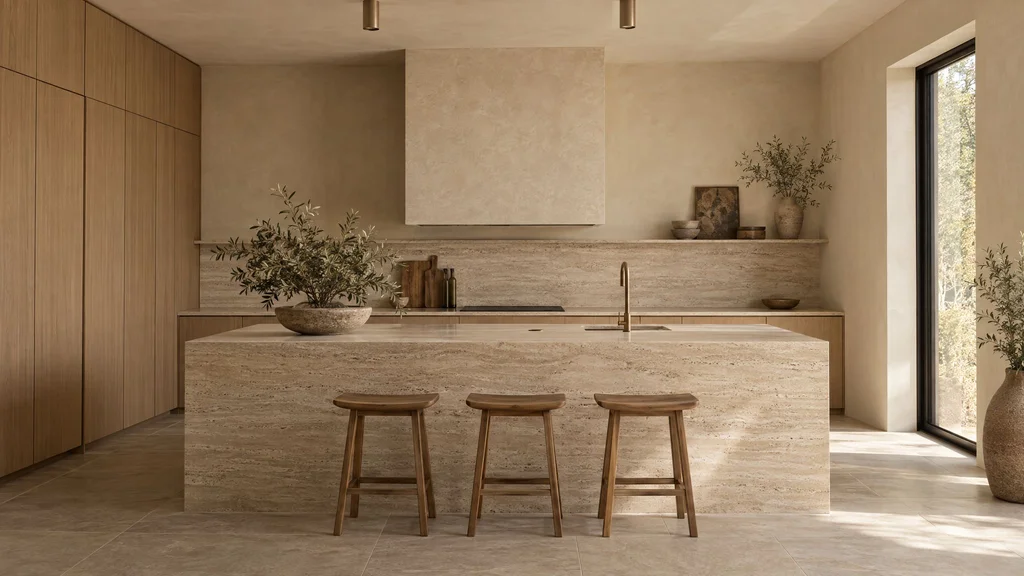
Minimalism once meant white lacquer, stainless steel and an almost clinical emptiness. Warm minimalism keeps the clarity and calm but replaces the chill with natural materials, soft textures and a sense of craft. It's one of the most requested looks we build: kitchens with clean lines and uncluttered surfaces that still feel welcoming, tactile and lived-in. This guide explains what defines a warm-minimalist kitchen, the millwork decisions that make it work, and the pitfalls to avoid.
What makes minimalism warm
Warm minimalism is defined by a few principles:
- Natural materials: wood, stone, plaster, linen and clay rather than synthetic, glossy surfaces.
- A restrained palette: two or three materials used consistently, in warm neutrals rather than stark white and grey.
- Texture over ornament: grain, veining, limewash and honed stone provide interest instead of moldings and decorative hardware.
- Hidden function: appliances, small appliances and clutter disappear behind cabinetry so surfaces stay calm.
- Craft and precision: with fewer elements, every joint, reveal and grain match is visible.
The wood
Wood is usually the primary material. Light woods such as white oak, ash and maple feel airy; walnut feels richer and moodier. Rift-sawn and quartersawn cuts give calm, linear grain that suits minimalism; see quartersawn, rift-sawn and plain-sawn and rift-sawn white oak. Grain direction and continuity matter: matching grain across a run of doors and drawers, often sequence-matched from the same veneer flitch, makes a wall of cabinetry read as one surface. See veneer matching explained and vertical vs. horizontal grain doors.
Finishes should be low-sheen and natural-looking: matte lacquers, hardwax oils, or cerused oak for subtle texture. See matte finish cabinets.
Handleless doors and hardware choices
Hardware is one of the biggest decisions in a minimalist kitchen. Options include:
- Integrated finger pulls: a routed or shaped edge on the door or drawer top that you grab.
- Channel (J-pull or C-channel) systems: a recessed horizontal channel between drawers.
- Push-to-open: mechanical or electronic openers so fronts are completely clean.
- Minimal hardware: slim edge pulls or small knobs in a material that matches or complements the wood.
Each has trade-offs in cost, durability and feel. Push-to-open can be finicky with heavy drawers; electronic systems need power. See best kitchen cabinet hardware.
Stone and surfaces
Warm minimalism favors stone with character: travertine, limestone, honed marble, quartzite or soapstone. Monolithic islands, with stone wrapping down the sides as a waterfall, are a signature element. Full-height slab backsplashes eliminate grout lines. Microcement and plaster on walls and hoods add soft texture. See waterfall islands and natural stone millwork.
Hiding everything
A minimalist kitchen stays minimalist only if storage is excellent. Plan storage for every item you own, and hide anything visually noisy:
- Integrated appliances behind matching panels. See integrated appliance kitchens.
- Appliance garages and pocket-door cabinets for coffee machines, toasters and mixers. See hidden pantries and appliance garages.
- Tall pantry walls with pull-outs.
- Drawer organizers for utensils, knives and spices so counters stay empty.
- Concealed hoods integrated into cabinetry or plaster.
Proportion, reveals and alignment
With little ornament, proportion carries the design. Align door and drawer lines across the room; keep reveals, the small gaps between doors, consistent; and make sure tall cabinets, appliance panels and drawers share a common grid. Toe kicks can be recessed and shadowed so cabinetry appears to float. This level of precision depends on exact shop drawings and careful installation.
Lighting
Warm minimalism depends on soft, layered light. Integrated LED under cabinets and in shelving, warm color temperatures around 2700K, and recessed or linear fixtures avoid visual clutter. Natural light is amplified by light woods and matte finishes. See kitchen lighting and cabinets.
Avoiding the pitfalls
- Too sterile: without texture and natural materials, minimalism turns cold. Use real wood and stone.
- Not enough storage: minimalism collapses when clutter returns. Plan storage generously.
- Fingerprints: handleless painted fronts show marks. Wood and textured finishes hide them better.
- Poor execution: uneven gaps and misaligned grain are glaring in a minimal kitchen. Choose a shop that sweats details; see signs of quality custom cabinetry.
Frequently asked questions
Is warm minimalism a passing trend? Its core principles, calm, natural materials and good storage, have been around for a long time and suit many homes.
Can it work in a traditional house? Yes, as a contrast to period architecture, or softened with a simple Shaker profile.
How does it relate to Japandi? They overlap; Japandi adds specific Japanese and Scandinavian references. See Japandi millwork.
A sample warm-minimalist material palette
To make the idea concrete, here's a palette that works in many homes. Cabinetry in rift-sawn white oak with a natural matte finish, with vertical grain running continuously across tall units and horizontal grain on drawer banks. Counters and backsplash in honed travertine or a warm quartzite, with the island wrapped in a waterfall. Walls in a warm white limewash. Hardware either integrated finger pulls or slim bronze edge pulls. Flooring in wide oak planks a shade darker than the cabinetry, or a warm limestone. Lighting in 2700K integrated LEDs, plus one sculptural pendant over the island. Every element is natural, matte and tactile, and none competes for attention.
Living with a minimalist kitchen
A warm-minimalist kitchen asks a little discipline of its owners: putting appliances away, keeping counters clear and resisting the urge to display everything. The reward is a room that feels restful every time you walk into it. Good design makes the discipline easy. When every item has a dedicated, convenient place, tidying takes seconds. That's why we spend as much time planning drawer interiors, pantry pull-outs and appliance garages as we do choosing wood and stone. The visible simplicity rests on invisible organization. If you're unsure whether minimalism suits your household, start with one wall of tall, hidden storage and see how it changes your routine.
Whatever direction you choose, the most successful kitchens start with a clear conversation about how you cook, entertain and store things, followed by careful drawings and honest advice about materials. If you'd like a second opinion on a design or a quote, we're happy to review plans and suggest where custom millwork will make the biggest difference for your home and budget.
See an example of a warm, natural kitchen in our Ridgewood kitchen post, or explore our custom kitchens.