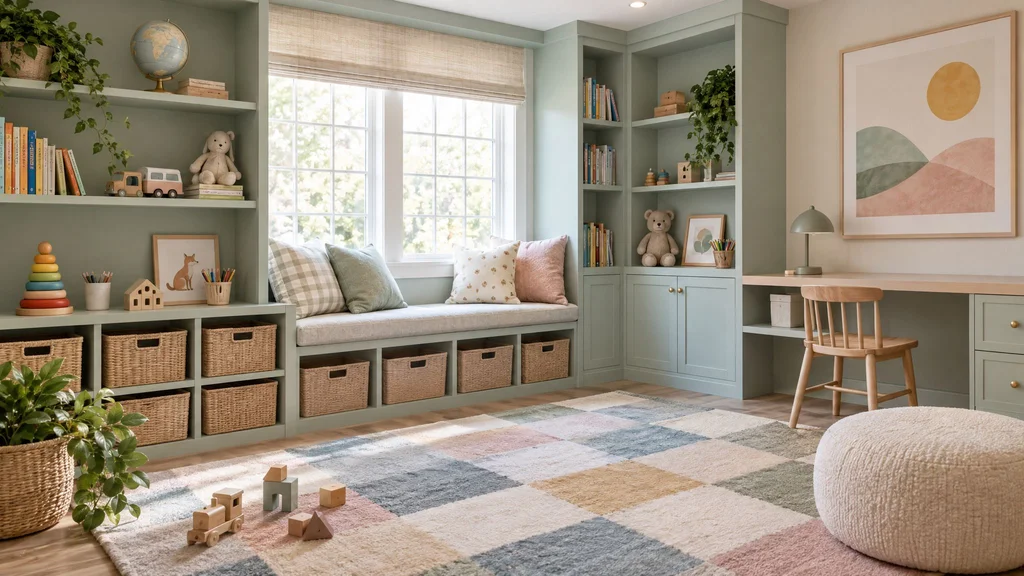
Every parent knows the feeling: toys everywhere, no system that lasts, and a room that seems to fill up faster than anyone can clean it. Custom built-ins can transform a playroom into a space that's easy to keep organized, safe for small children, and flexible enough to evolve as kids grow from toddlers to teenagers. Here's how we design playrooms that last.
Design for how kids actually use the room
Children need to reach their things and put them away independently — that's the secret to a playroom that stays tidy. Low, accessible storage with clear categories (bins for blocks, shelves for books, a drawer for art supplies) makes cleanup a game rather than a battle. Higher storage keeps items that need supervision, or out-of-season toys, out of reach.
Cubbies and bins
Open cubbies with fabric or wooden bins are the backbone of most playroom storage. They're easy for kids to use, hide visual clutter, and can be relabeled as interests change. Size cubbies to fit standard bins so replacements are easy to find.
Adjustable shelving
Adjustable shelves let storage adapt as kids grow — from picture books and stuffed animals to board games, trophies, and school books. It's one of the simplest ways to make built-ins last a decade or more.
Reading nooks
A cozy reading nook — a built-in bench with cushions, flanked by bookshelves, perhaps under a window — gives kids a special place to read and relax. Add a reading light and front-facing book display shelves so covers entice young readers. See window seats with hidden storage.
Art and craft stations
A built-in art table or counter with durable surfaces, drawers for supplies, and a display rail or corkboard for finished work keeps creative mess contained. Choose wipeable surfaces and finishes that tolerate markers and glue.
Homework and desk areas
As children grow, a playroom often becomes a homework space. A built-in desk with good lighting, cable management, and storage can be designed from the start, or added by converting lower cabinetry later. Planning outlets now makes future tech easy.
Display for collections and artwork
Kids love showing off their creations and collections. Picture ledges, display shelves, and magnetic or cork panels integrated into the millwork let displays change without new holes in the walls.
Safety first
- Anchor everything: tall built-ins must be securely fastened to wall framing to prevent tipping.
- Soft-close hardware: prevents pinched fingers and slammed doors.
- Rounded edges: eased corners and edges reduce injuries.
- Lid stays: lift-top benches need slow-close supports so lids can't fall.
- Non-toxic finishes: choose low-VOC paints and finishes.
- No climbing temptations: avoid designs that look like ladders on tall units.
Durable materials and finishes
Playrooms take abuse. Durable painted finishes in scrubbable paints, hardwearing species, and protective edges extend the life of built-ins. Painted millwork is popular because it can be touched up easily. For finish selection, see our finishes guide and painted vs. stained cabinets.
Color and design
Rather than committing to a theme that will be outgrown, choose a timeless palette for the built-ins — soft whites, warm neutrals, or a gentle color — and let bins, art, and textiles bring personality. When the room shifts from playroom to teen lounge or study, the millwork stays appropriate.
Planning for the future
The best playroom built-ins are designed for the next stage: cubbies that can take doors later, a bench that becomes a lounge seat, shelves that hold books instead of toys, and space for a TV or gaming setup as kids get older. See designing a custom media wall.
Kids' closets and bedrooms
Many families extend playroom thinking into bedrooms and closets: adjustable rods, low hooks, and shelves that move up as children grow. See custom kids' closet design.
Cost factors
Cost depends on the extent of built-ins, doors versus open storage, special features like reading nooks and desks, lighting, and finish. A single wall of cubbies is modest; a fully designed playroom with a nook, desk, and display walls is a larger investment that serves for many years.
Frequently asked questions
At what age should we build playroom built-ins? Any age works, but designing with adjustable and convertible elements means the investment serves from toddler years through the teens.
Open cubbies or doors? Open cubbies with bins are easiest for young kids; doors hide clutter and suit older children. Many families start open and add doors later.
What paint finish is most durable? A hard, scrubbable satin or semi-gloss finish in a quality cabinet paint holds up best to little hands and cleaning.
How do you prevent tipping? Every tall unit is anchored securely into wall framing during installation — a non-negotiable in rooms used by children.
Can a playroom share space with a guest room or office? Yes. Built-ins with doors can hide toys entirely, and a daybed or desk can be integrated so the room serves several purposes.
A room that grows with them
The families who get the most from playroom built-ins are the ones who plan for change. Today's toy bins become tomorrow's book storage; today's art table becomes tomorrow's homework desk; today's reading nook becomes a teenager's favorite hideaway. Good millwork makes those transitions effortless.
Planning checklist
- List everything the room needs to hold today — and what it might hold in five years.
- Measure your kids' reach so the most-used storage is low enough.
- Choose standard bin sizes before finalizing cubby dimensions.
- Plan outlets for a future desk, lamp, and devices.
- Pick a timeless finish color and let accessories carry the theme.
With a thoughtful layout and durable materials, the playroom becomes the room that works hardest in the house — and the easiest one to reset at the end of the day. That's the payoff of designing storage around how children actually play, rather than around how a catalog photo looks.
Related reading: home gym millwork, window seats with storage.
If your playroom needs a system that actually works, we'd love to help. Call (201) 281-1457 to talk about custom built-ins for your family.